After the exit from the Metropolitan Football Association (now VAFA) at the end of season 1900, Kew re-joined the revamped Metropolitan Juniors in the lower ranks of 3rd and 4th Rate. Lacrosse had taken over from football as the major winter sport in the Borough of Kew and the standard of football had dropped momentarily, but rose again when seventeen (17) year olds Eric Watson and Harry Walker signed up with and played for Fitzroy and Richmond respectively.
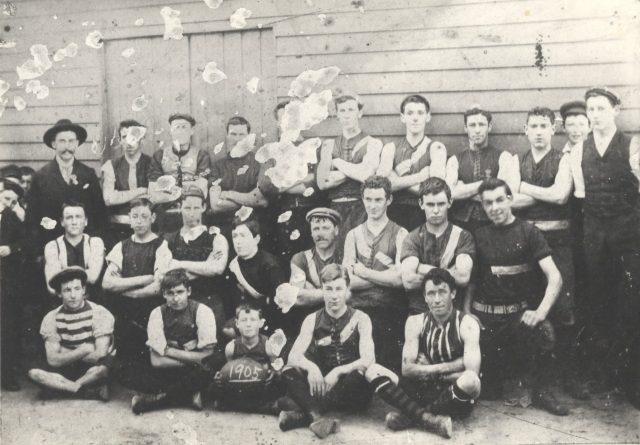
The increased strength and standard of the players prompted Kew officials to enter the senior ranks of the Reporter District Association (now Eastern Football League). The club received a bonus when young Watson decided to reject Fitzroy’s offer and returned to Kew, playing for another ten years. Five other players also were snapped up by VFL clubs, viz. Henry and Patrick Brady (Melbourne), Stan McKenzie, Matt Cody and Tom Hammond (Collingwood).
Kew was a member of the Reporter Association for eight seasons, but, due to the club and competition going into recess for three years owing to World War I, only five seasons were played. It was a successful era with finals being played in all but one year. No premierships were won but the club was runners up to Mitcham in 1914. You can read the full match report from that game below!
After a strong third finish in the 1919 Reporter FA season club officials decided to transfer to the Victorian Junior Football Association. This competition was for VFA Reserve teams and also a proving ground for aspiring clubs wishing to join the senior ranks of the First XVIII VFA competition. The initial seasons were hard on players, officials, members and supporters with disastrous losses, but improvement was slow and steady once the side settled down.
—-
REPORTER DISTRICT FOOTBALL COMPETITION.
FINAL MATCH.
KEW v. MITCHAM.
Mitcham (8.9) beat Kew (4.7)
The football curtain for season 1914, so far as the above competition is concerned, was rung down last Saturday afternoon, when the final match between these teams was played on the Camberwell oval. Should Kew have won, a grand final would have been necessary, as Mitcham held the right of challenge on account of winning the minor premiership, but from first to last the former were not “in the hunt,” and the Mitchamites scored an easy victory by a margin of 26 points to their advantage. It closes a most creditable season for that club, as it is doubtful whether any other club can put up such a unique record as going through the year without a single defeat. True the team played two drawn games, and won its semi-final by only one point against Blackburn, but nevertheless the performance of not having its colours lowered once was such as to be distinctly proud of.
There was an excellent gathering of football enthusiasts from all parts of the “Reporter” district, and the attendance must have numbered well over 1000, each side being strongly supported. It was exceedingly unfortunate that the high wind which prevailed during the greater part of the afternoon should have spoilt the game to some extent. It favoured the south at the eastern end, and this had the effect of not only keeping the ball out of bounds on the wing, but rendering accurate shooting for the big uprights rather difficult. The Mitcham team represented the strongest side the club could put into the field, but Kew was not so fortunate, as although Laidlaw and Scott, who are members of the victorious team at Broadmeadows, both were able to play, the fifteen was considerably weakened by the forced absence of their two rovers, Rendy and Tate, each of whom was suffering from illness, and the former, who played such a conspicuous part in the team’s victory in the first semi-final, left a blank which the club found impossible to fill. The teams were as under:-
KEW.-Backs: H. Urne, T. Bumbell, J. Jackson; half-backs: W. O’Brien, L. Shacklock, S. Coburn; centres: C. Swallow, J. Fraser, J. Scott; half-forwards: O. Martin, N. O’Hehir, T. Anderson; forwards: L. Rose, Dundy, D. Laidlaw; followers: L. Anderson, E. Bastard; rover: L. Potts (captain).
MITCHAM.-Backs: G. Dempster, Jim Hiker, J. Petty; half-backs: S. Crowther, M. George (captain), C. Cooper; centres: E. Stewart, A. Burgess, T. Gilchrist; half-forwards: W. Ward, W. Brownjohn, G. Ward; forwards: W. Usher, J. Sandilands, W. Nolan; followers: Joe Hiker, W. Kennedy; rover: T. Gale.
It was nearly four o’clock before the umpires were commissioned, for notwithstanding that both teams were timed out on the field, some delay was caused through an argument between the rival captains as to the time to be occupied by each quarter. The toss of the coin gave Mitcham the advantage of the breeze and the opening kick, but this did not produce anything sensational, the play being of a very sedate and easy order. A series of pretty passes by Kew sent the oval well forward, but when it reached the forward lines a long punt on the part of Crowther was carried by the elements towards the opposite end. Mitcham were far too strong to be lightly tackled, as long kicks, with the wind behind them, repeatedly stopped every attack. Their followers formed a strong combination and again drove the sphere into their opponents’ territory, but without success. On several occasions these attacks were repelled by sound defensive work on the part of George, Crowther and Cooper. Although Kew’s followers and the blue and whites broke through, and after another minor had been scored, play was concentrated on the wing until the quarter ended, when the scores read:-
Mitcham – 2 goals 2 behinds.
Kew – 1 behind.
The latter entered upon the next section with determination to wipe out their leeway with the assistance of the breeze, but some splendid opportunities were missed. For a while the ball hovered round the Kew forward lines, and eventually a “pot shot” from the wing produced a behind, followed by another immediately after. Kew were wasting valuable time, as their attacks lacked cohesion and sting, and the Mitcham backs were triumphing in the air with high marks, which continually saved the situation. Fraser was playing cleverly for Kew, and from a mark on an angle notched their first “sixer.” This invigorated his club mates to greater things, and they made another bold dash for the goal, and a single was added. Mitcham then transferred the play, and no further scoring eventuated before half-time, when four points separated the combatants, as follows:-
Mitcham – 2 goals 2 behinds.
Kew – 1 goal 4 behinds.
Play in the third term on the part of the leaders practically determined the issue. Several Mitcham onslaughts were at first repulsed, but at length they landed a major point from a snapshot by Chalmers, which was followed in a twinkling with another from the boot of Jim Hiker, who had gone into the ruck. Kew then rallied, and by systematic play forwarded, where Bastard snapped a goal. This concluded the latter’s share of the scoring this term, as from then until the last change of ends Mitcham kept up an incessant bombardment of their opponents’ citadel. The efforts were mostly made from short body drops, but occasionally a sharp centre move was forced. Kew appeared to become slightly disorganised, and their backs were continually being called upon to repulse the strongest of counter movements. No fewer than 4 goals 6 behinds were tacked on by the men in red, and the concluding change was entered upon with the relative positions:-
Mitcham – 7 goals 8 behinds.
Kew – 2 goals 4 behinds.
With that wide disparity in the scores, the most sanguine Kew supporter could not have looked upon the state of the game with any apprehension of success, but, of course, with the aid of the wind, there was still a small degree of hope. For a time there was no scoring, but ultimately Mitcham succeeded in again reaching the danger zone, where they added a minor. Kew responded with a goal through the agency of Rose, but the tricolours were not to be outdone, and transferring the venue, Chalmers marked and posted another big point to his credit. From then on, however, Kew took command, but their forward play was lacking, and overshadowed in many instances by the defensive work of Mitcham. Three behinds came, the last of which was from a shot right in front, and subsequently Fraser, by skilful play, raised the two flags, but their scoring ended, for although Kew made several sustained attacks, they were not equal to any further addition to their tally, as the wind had dropped considerably, and the final bell declared Mitcham premiers to the shouts and loud cheering of their large contingent of barrackers, as follows:-
Mitcham – 8 goals 9 behinds (57 points).
Kew – 4 goals 7 behinds (31 points).
Goal-kickers.-Mitcham: Chalmers (3), G. Ward (2), Jim Hiker, Sandilands, Kennedy. Kew: Fraser (2), Bastard, Rose.
There was no question but that the better side annexed the honours of the day, and their superiority was marked, with the exception of a few spasmodic dashes, throughout the match. It was therefore with every credit that Mitcham came out on top. No player did more towards the victory than the captain, “Mickey” George, who invariably chipped in at the right moment, and what he did he performed well. His long experience as a skipper also stood his team in good stead. It was somewhat singular that he should have led the Four Trees Gully team to the premiership position last season. The remainder of the players on the winning side likewise displayed excellent form, and in marked contrast to their showing against Blackburn the previous Saturday. Joe Hiker played well in the ruck, though he lacked precision in his kicking, but he is by no means the footballer he was a year ago, exhibiting signs of staleness. Burgess again did some sensational runs down the centre, but occasionally would have done better had he taken his kick earlier. Brownjohn gave the club his best game for the season. Nelson, Dempster, Chalmers (who was active forward), Petty, Kennedy, Joe Hiker, and Stewart all showed out to their usual good standard.
Kew were a much lighter team than their opponents, and being also smaller in stature were invariably beaten in the air, though they were faster on ground play, and sometimes held Mitcham at bay with short passing. A conspicuous figure in their colours was Martin, who at different stages of the game was undoubtedly the best player on the ground. The brunt of the defensive work fell on Shacklock, who likewise did his duty well. Fraser (centre and roving) was in his best form, and showed much cleverness in eluding the opposition. Swallow and Scott (on the wings), Laidlaw (half-forward), and Potts (roving) all gave a good account of themselves.
Umpire J. V. Young had charge of the game, and performed his duties capably, and to the satisfaction of both teams. Although his undertaking was rendered more arduous by reason of the adverse circumstances caused through the influence of the wind, he exercised wise discrimination, and controlled the play with precision and foresight. He had as his assistants boundary umpires T. Ritchie and Davey. Messrs. M. Hayes (Blackburn) and W. Coblin (Ringwood) officiated as goal umpires.
—-