Victoria Park, Kew
EMAIL US:contact@kewfc.com
Kew Football Club is first recorded in Mark Penning’s Origins of Australian Football publication in 1876, with the formative years of the club being played in the 2nd and 3rd rate ranks of the Hawthorn Division. Kew, although a farming area of orchards and sheep agistments at the time, was a very early starter in the football stakes.
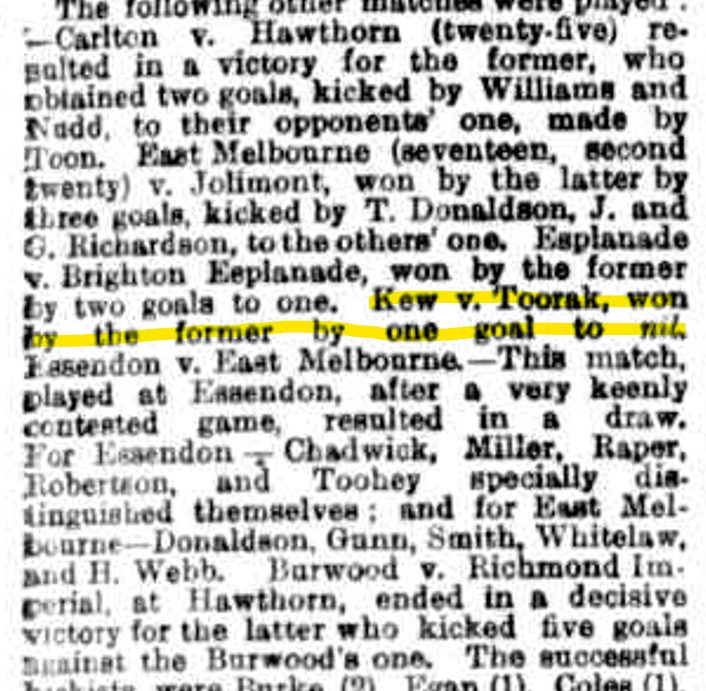
It wasn’t; however, the first club formed in Kew. That honour belongs to the Studley Park FC that was founded in 1871 and won its first premiership, co-incidentally, in 1876 in 2nd Rate ranks. Its home ground was a vacant block on the corner of Studley Park Rd and Carson St, Kew.
There were a large number of teams formed in the Kew area, but most clubs lasted intermittently over a short time, and then disbanded. Names such as Kew Highfield, Kew Mayfield, Kew Moonlight, Kew Imperial, Kew Alberts and East Kew. Other local clubs had names like Edlington, Excelisor, St George and Orlinda. The Orlinda FC was so named after the secretary's home district back in England. Orlinda lasted for three or four years playing in the second season of the VAFA (then Metropolitan Junior FA) during 1893. A Kew Juniors (or second 20) was also playing by 1879 alongside the Kew Mayfield team which represented Holy Trinity Church of England. This old blue stone church still stands in the middle of Kew shopping centre on the corner of High and Pakington Streets.
All the above clubs flourished for a short time, but waned and disbanded, bar the Kew Mayfield club which lasted until 1940 but not without name changes. Firstly, to Holy Trinity (Kew) FC, then to Kew United (Churches) FC and finally to East Kew FC playing in the Eastern Suburban FL and winning a premiership in 1938. The club, however, went into recess for 1941 due to enlistments in World War II. The remaining players joined up with Kew which survived for one more season before also going into recess.
How does Kew’s establishment date compare with some of the old VFA and VFL clubs?
The oldest club is Melbourne FC, established in 1858 after the first game between Scotch College and Melbourne Grammar School. This first game between the two schools is still played to this date (2026) and both schools have Old Boy teams participating in the VAFA competition. Both Old Scotch and Old Melburnians had a strong rivalry with Kew from the 1950’s to 1990’s.
After this first game the gentlemen of Melbourne Cricket Club challenged the gentlemen of South Yarra and thus this latter club was also formed at this time. Brighton, Geelong and University followed one year later with Carlton and Williamstown (1864) and North Melbourne (1869) following soon after. During the early 1870’s Essendon, Footscray, Port Melbourne, South Melbourne and St Kilda were all formed. It can be seen that the Kew club was formed (albeit in the 3rd and 4th Ranks) before a large number of senior clubs in the inner suburbs. Clubs like Fitzroy, Northcote, Richmond, Brunswick were formed after Kew with some starting off as a Junior team (U23) before advancing to senior status in a few short years.
Collingwood was a relative late starter in 1892 but Hawthorn was really dragging the boots when formed in 1902 to play in the Metropolitan Football Association (now VAFA). The club was formed from the Waterloo club and the Hawthorn Trades club, both of which had no local ground, and the new Hawthorn club had secured a playing field on Grace Park, but no team.
There were also early regional teams formed mainly in the larger junction towns of Ballarat (1860), Sandhurst (1861) and Castlemaine (1869).
Kew won its first flag in 1880 in the 3rd Rate Ranks of the Hawthorn Division and another flag followed in 1886 in 2nd Rate ranks. With this success the club believed it was ready for the senior ranks of the Victorian Junior Football Association (VJFA).
The VJFA ranks were attained for season 1889 after two building seasons of Second (2nd) Rate competition. Club President His Worship The Mayor Councillor Charles Staples also convinced the VJFA that Kew was ready for First (1st) Rate ranks and that Park St Reserve (now Victoria Park) would be the home ground and not the distant O’Shaunessy’s Paddock (corner of High St South and Barkers Rd), which, though handy to the Victoria Bridge Horse Tram terminus which was transport for the earlier inner suburban teams of Hawthorn, Richmond and East Melbourne, was distant from the heart of Kew.
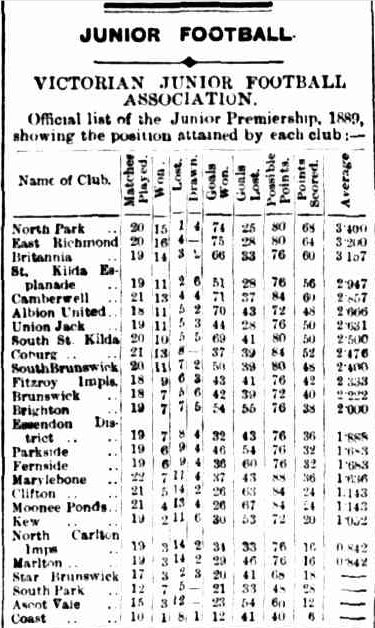
Although performances were modest in the higher VJFA the club held its own. However, bad times weren’t faraway when the ravages of the 1890’s depression hit and the gold rush in Western Australia at the same time. Players of all clubs, senior, junior and lower rate ranks all suffered with players seeking employment elsewhere or off to make their fortune in Western Australia.
After a winless 1891 season the club dropped to 3rd Rate ranks of the VJFA. The private Kew High School team had been admitted to the Schools Amateur Athletic Football Association (now Associated Grammar Schools) and the Kew based Orlinda club (home ground was Hyde Park) played games against Collegians (ex Wesley College) one year before the VAFA was formed as the Metropolitan Junior Football Association.
When the VJFA passed a resolution that all clubs must play on an enclosed ground, and as Cemetery Reserve was unfenced, it was decided Kew would go into recess.
A revival occurred in 1899 when Kew re-emerged and joined the Fourth Grade of the Suburban FA. After four games a vacancy occurred in the Metropolitan Juniors (now VAFA) of which Kew quickly applied to fill, and was accepted, taking the place of St Francis Xavier College (now Xavier College).
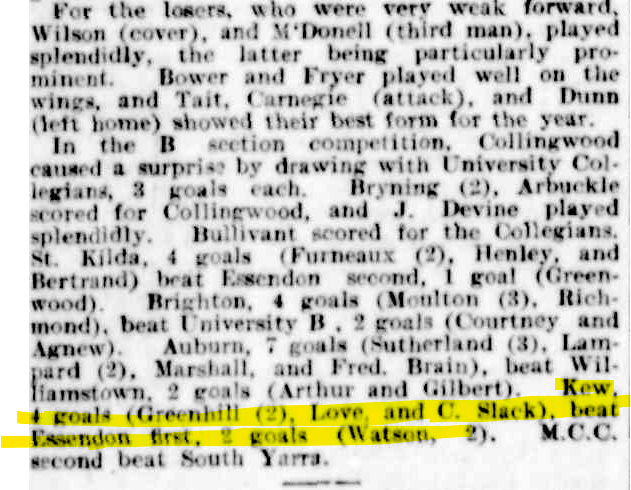
After two modest seasons Kew returned to the 3rd Rate ranks of a new Metropolitan Junior association.
After the exit from the Metropolitan Football Association (now VAFA) at the end of season 1900, Kew re-joined the revamped Metropolitan Juniors in the lower ranks of 3rd and 4th Rate. Lacrosse had taken over from football as the major winter sport in the Borough of Kew and the standard of football had dropped momentarily.
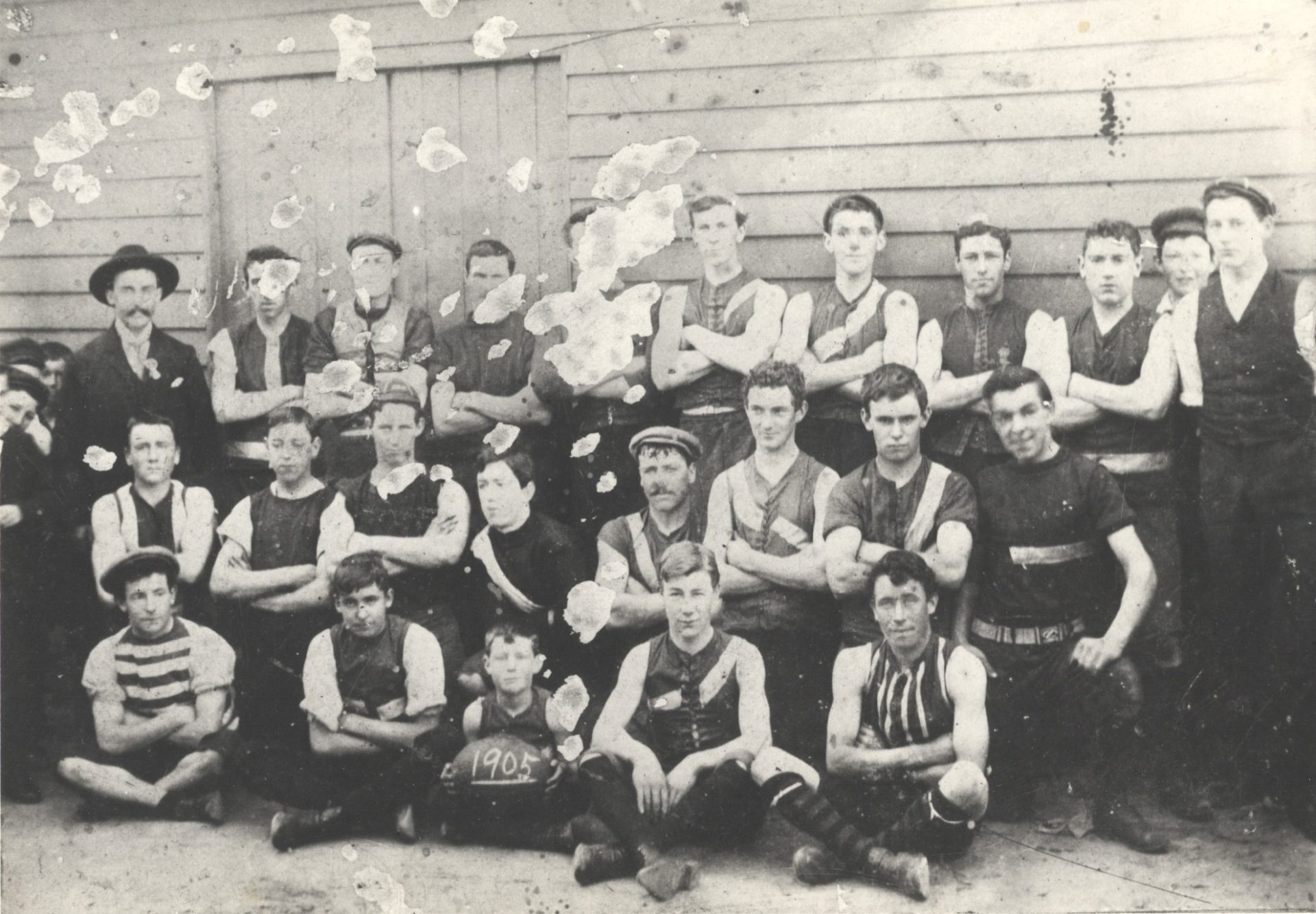
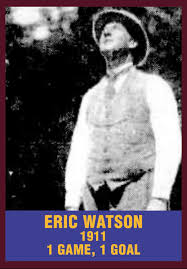
The standard of football rose again when seventeen (17) year olds Eric Watson and Harry Walker signed up with and played for Fitzroy and Richmond respectively. The increased strength and standard of the players prompted Kew officials to enter the senior ranks of the Reporter District Association (now Eastern Football League). The club received a bonus when young Watson decided to reject Fitzroy’s offer and returned and played for another ten years.
Five other players also were snapped up by VFL clubs, viz. Henry and Patrick Brady (Melbourne), Stan McKenzie, Matt Cody and Tom Hammond (Collingwood).
Kew was a member of the Reporter Association for eight seasons, but, due to the club and competition going into recess for three years owing to World War I, only five seasons were played. It was a successful era with finals being played in all but one year. No premierships were won but the club was runners up to Mitcham in 1914.
After a strong third finish in the 1919 Reporter FA season club officials decided to transfer to the Victorian Junior Football Association. This competition was for VFA Reserve teams and also a proving ground for aspiring clubs wishing to join the senior ranks of the First XVIII VFA competition.
The initial seasons were hard on players, officials, members and supporters with disastrous losses, but improvement was slow and steady once the side settled down.
The early years of re-joining the VJFA were meagre for wins, but the club was determined to make a go of it with the aim of eventually joining the coveted ranks of the VFA, which competition was second only in status to the VFL.
The first year of VJFA football (1920) is best forgotten despite the efforts of Captain/Coach Fred Keays (ex-Fitzroy) who tried to lift the standard of the locals and import a few senior players to show the way. Two forfeits was not a good look for the aspiring Kew in this senior competition. However, bright spots were the selection of Hugh Smith and Jones for VJFA representative team with promising teenager (16 yo) Trevor Rowlands holding his own. Trevor would go on to represent University Blacks and Collingwood and also captain cricket for his adoptive state of Western Australia, where he transferred for work reasons as a Classics Master at The Hale School. A sad note was the retirement of Eric Watson who had represented Fitzroy as a seventeen (17) year old ten years earlier.
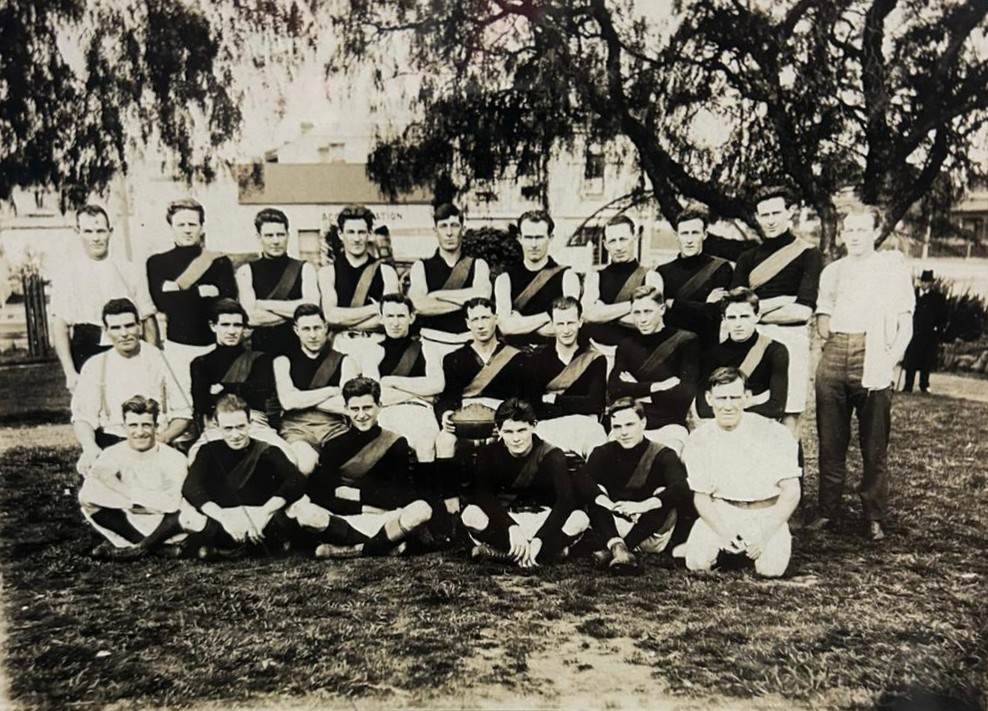
The following three seasons were also formative with only a handful of wins each season, but confidence was growing amongst the players and club as the number of wins per season kept on growing with fifth position gained in 1924 in the First Division. However, whilst an improvement in form made Kew a worthy opponent, the final four eluded the club.
Successful times were now within reach and the committee were planning to achieve the aim of finals and a premiership.
Kew flirted with the prospect of becoming a full VFA senior member when Brunswick was temporarily excluded from the competition after sixteen rounds of 1926. Although VFA officials were "greatly impressed" with the club's home ground and surroundings, its application was unsuccessful and Brunswick remained in the VFA for the 1927 season.
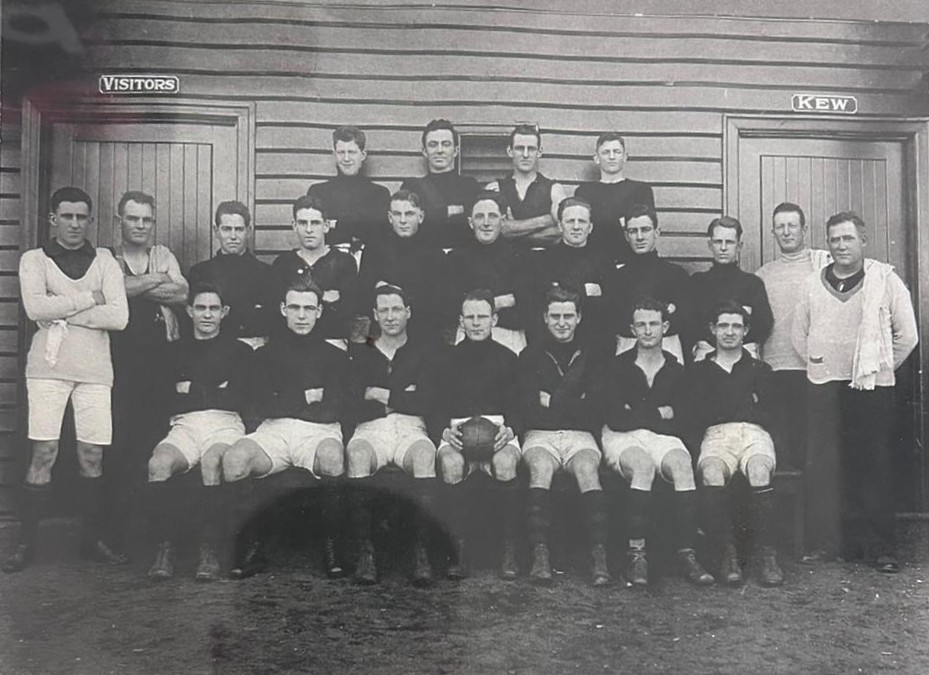
During this period the VFA passed a resolution that the VJFA would become a competition only for teams that were the Juniors (2nd XVIII) of a senior VFA team. As Kew was a standalone ‘junior’ club, it was on the move again, and entered the VFL sponsored competition named Victorian Football League Sub District Football League. Competing clubs would be a second 2nd XVIII of a VFL club in its nominated area fielding players that were potential VFL recruits.
The first step was in appointing recently retired Essendon champion Jack Garden as Captain Coach with local veteran and cousin Bill Reilly as Vice-Captain. Eddie Dimmick formerly of Northcote via Melbourne 2nds, Johnny Egan, Frank Maple and Frank Magrath returned from Hawthorn and improvement from youngsters who earlier had played VJFA lifted the standard and Kew was on the move.
The Sub District First Division fielded an unwieldly thirteen (13) clubs, but this did not deter Kew as after the Round 10 bye the club did not lose its position in the four. Finishing equal 4th on 13 wins with Public Service and Auburn, and with East Brunswick a game clear as Minor Premiers.
In an upset Kew defeated the Minor Premiers and advanced to the Final to meet and defeat local rivals, Auburn. The Grand Final was played at Oakleigh in teeming rain with East leading at quarter time, Kew steadied in the second and gained the lead which they never lost, winning by a comfortable 21 points. It was Kew’s third flag, some 41 years since the second in 1886.
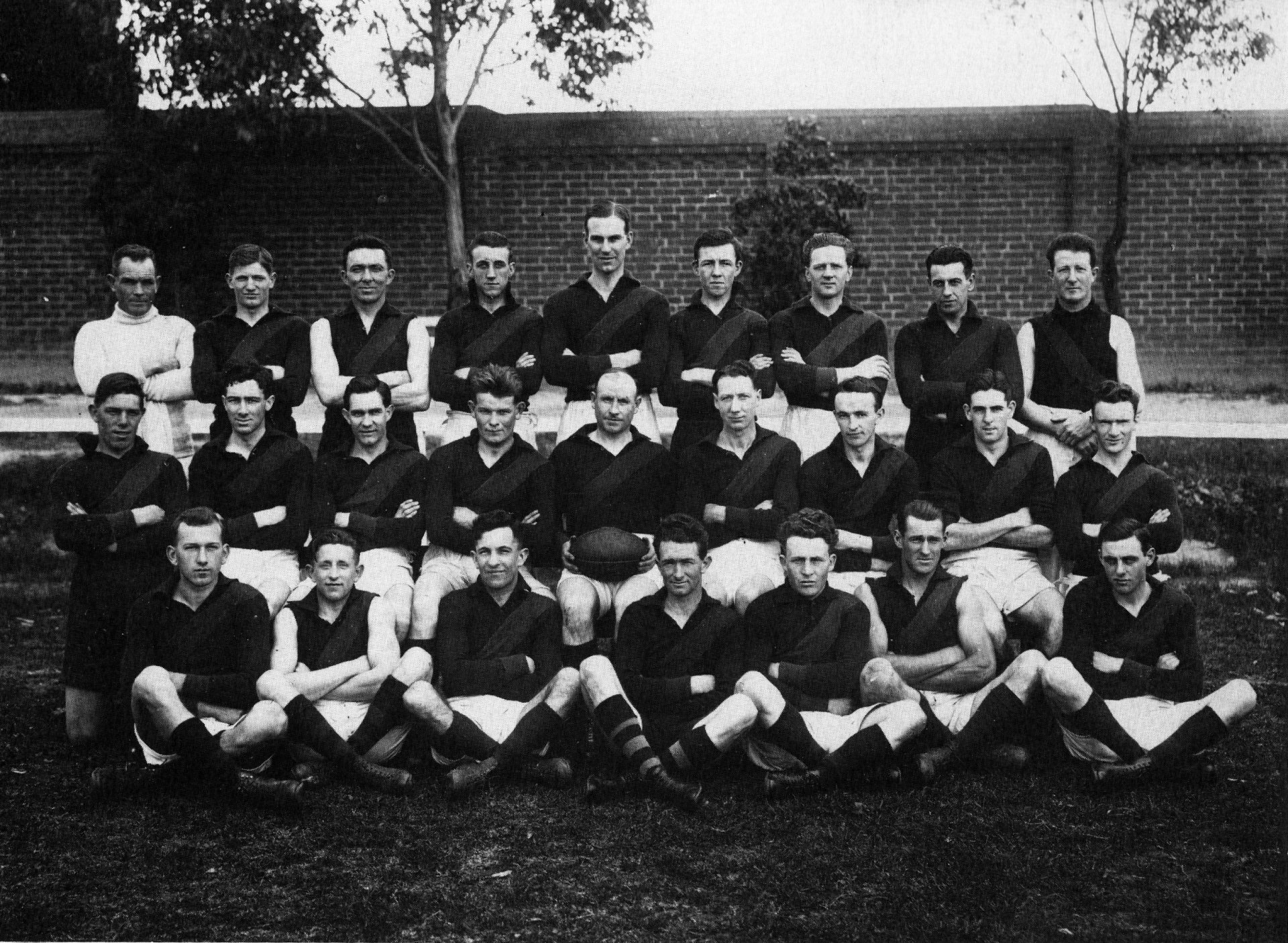
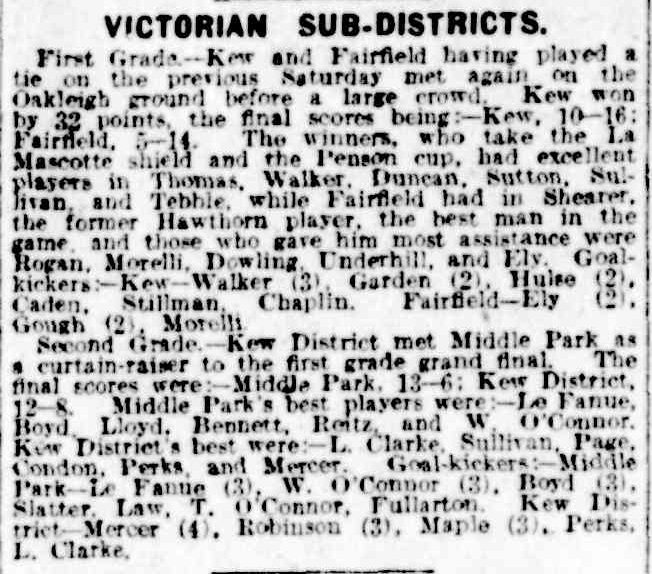
Following the 1927 flag, Kew suffered a premiership hangover for the 1928 season. Finishing fifth with two (2) lots of successive three (3) game losses and it was fifth position. But the wheels were back on in 1929 with top position and the Minor Premiership. A three-goal win against South Melbourne District in the Second Semi Final was advancement to the Final, however an inexplicable loss to Fairfield in the Final meant the Right of Challenge held by the Minor Premiers was used and the Grand Final was an 8 – 8 draw. The Grand Final Replay was won easily by 32 points to notch a second flag for Captain Coach Jack Garden.
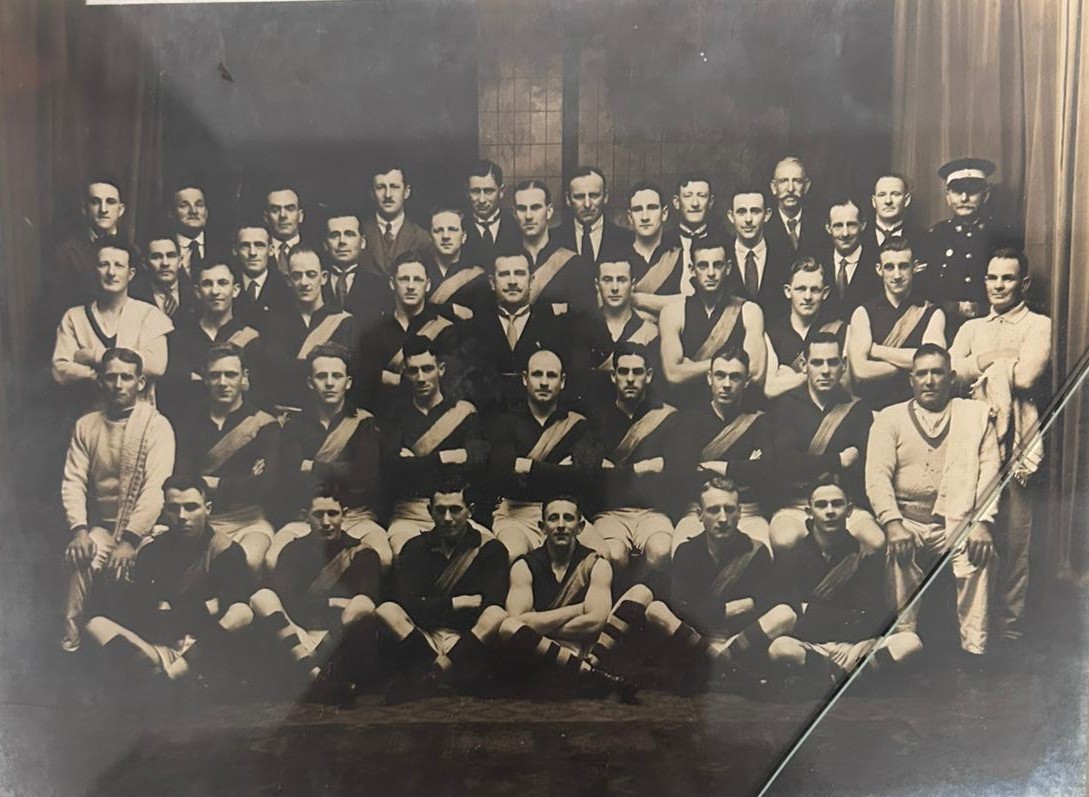
A poor start to 1930 with only two wins after round seven (7) and playing catch up footy Kew was one game short of the final four at the finish under new Captain Coach Ivo Aldridge with playing experience at St Kilda and Captain/Coach duties at Brighton and Blackburn. He was not reappointed the following season.
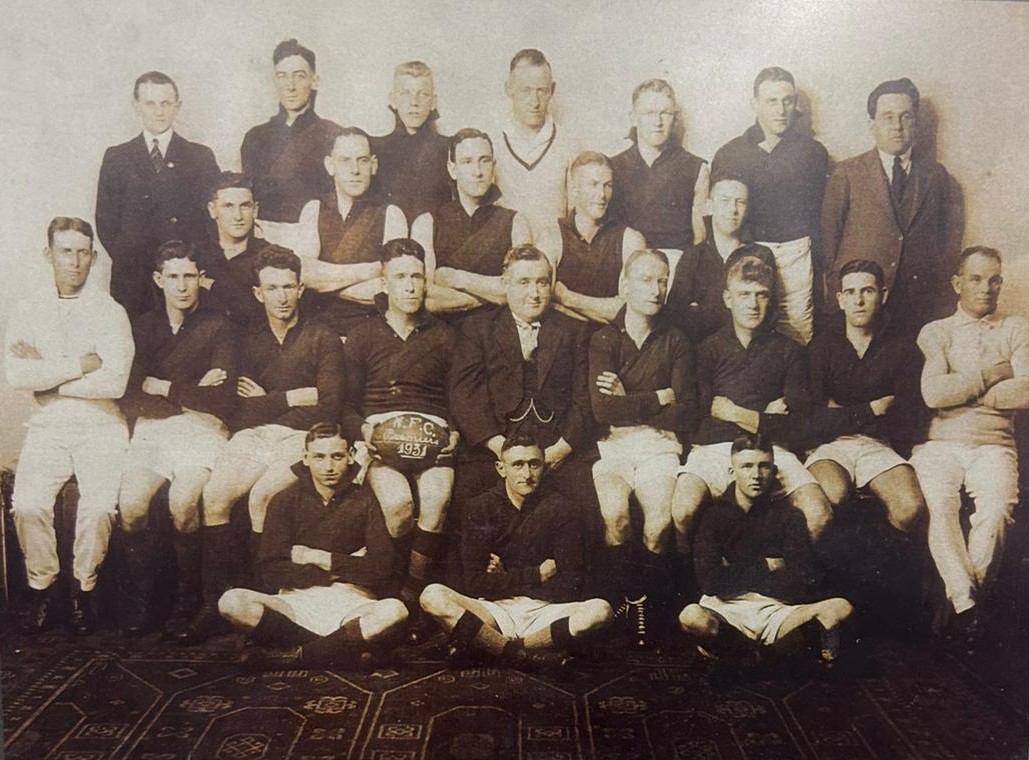
The selection of former Footscray Vice Captain and VFL Representative, Alby Outen, rejuvenated the club when consecutive flags were won in 1931 and 1932. Keith Marshall was firing and a focal point at Full Forward with 67 and 92 goal totals in those years respectively. The winning of the 1931 flag entitled Kew to become the permanent holders of the La Mascotte Shield being the first club to win three flags in the Sub District League. This shield hangs proudly in the Social Room.
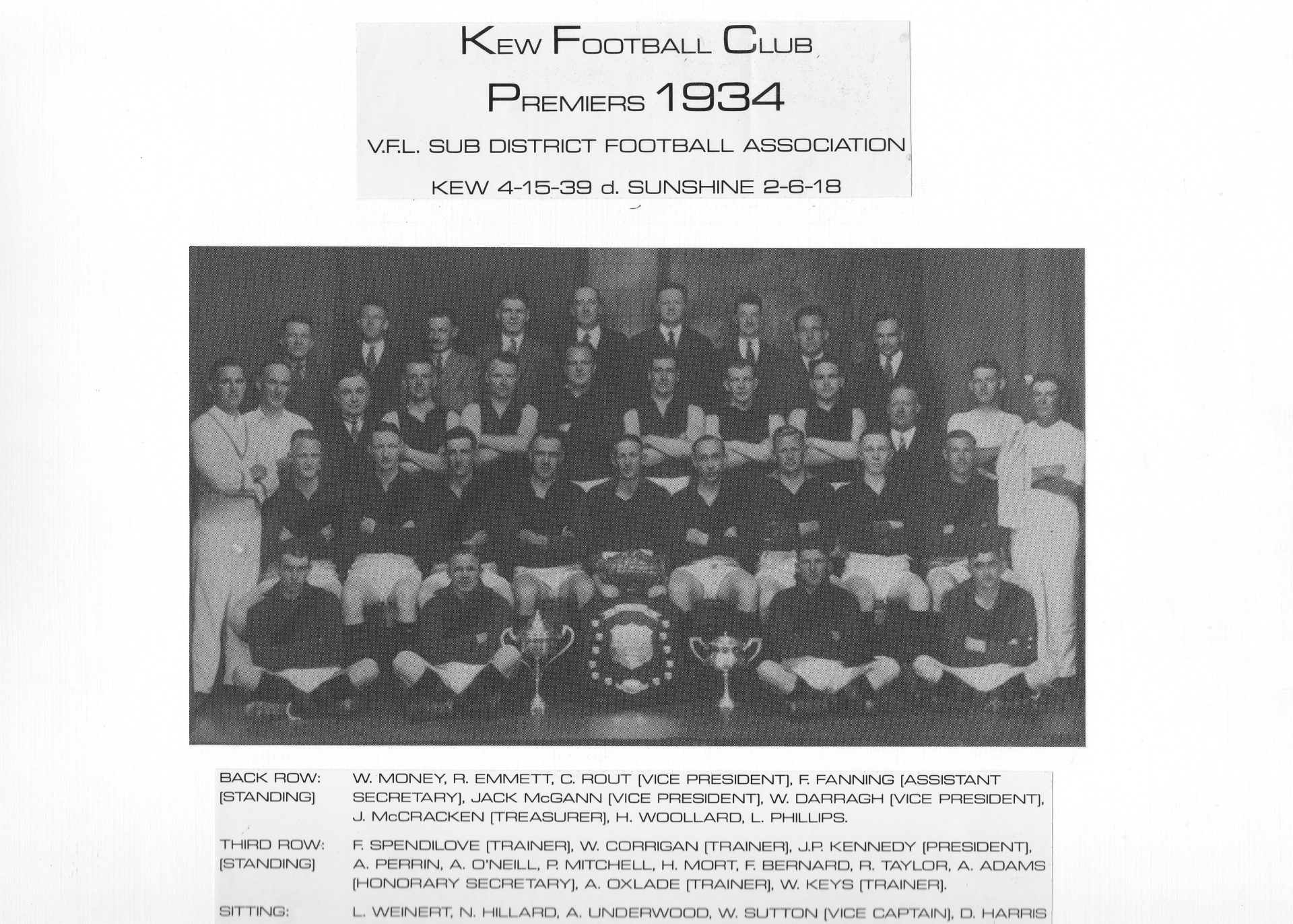
The Melbourne Centenary Flag of 1934 was next on the agenda with a fine exhibition in extremely wet conditions against Sunshine, under new Captain/Coach Don Harris of Richmond and Collingwood fame.
1935 would see another finals berth that was ultimately unsuccessful, a premiership eluding the club by the barest of margins. The VSDL Grand Final was a rough affair and ended in a draw, with each team scoring 76 points. Kew then lost the Grand Final replay the following week.
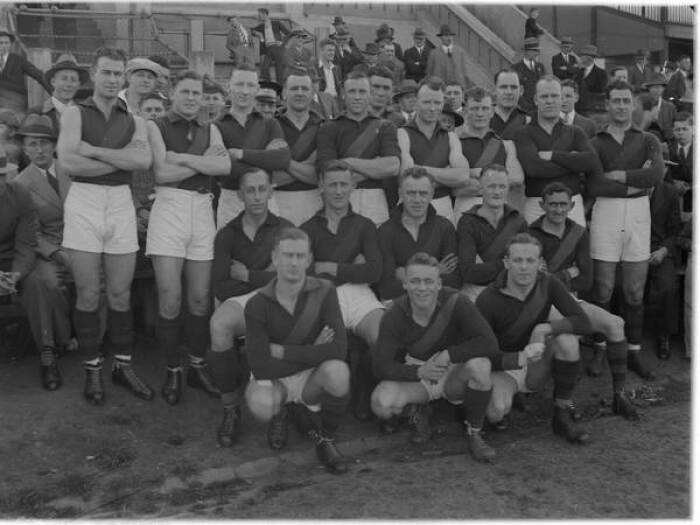
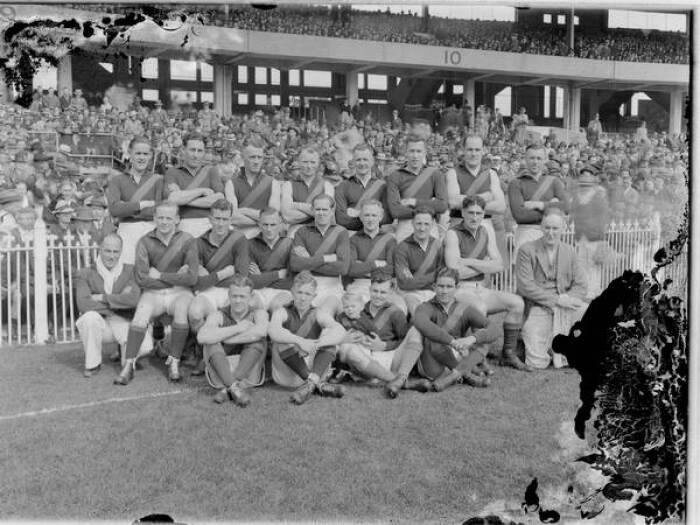
Finals finishes were achieved in all seasons bar 1937 and 1940, but with no success to show for it. From 1937 the Sub-District League Grand Final had been played as a curtain raiser for a VFL Finals game at the MCG. This represented a major coup for the VSDL, and in 1939 Kew would qualify to play South Melbourne Districts in the big game.
Kew headed the Southerners at the last change but was overrun in the last quarter, kicking a miserable four behinds to South’s 6 goals 6 behinds. The final score: 14.15 (99) to 9.13 (67).
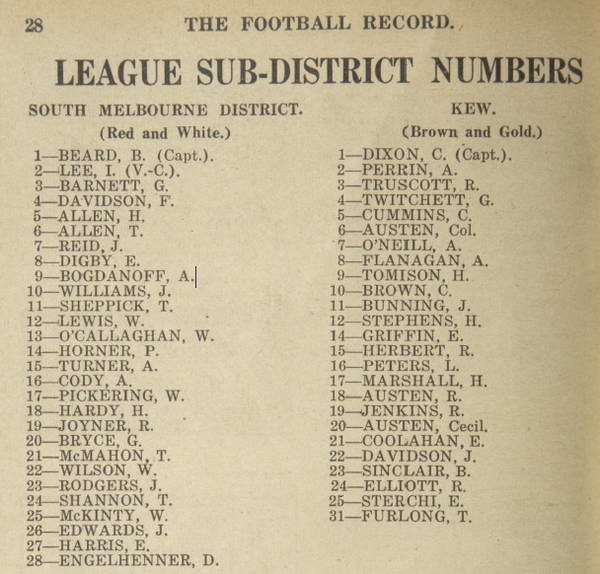
Under the war clouds of World War Two the 1941 season was the first, but certainly not the last, for former Richmond and VFL Representative and champion rover, Ray Martin, as Captain Coach. The team finished the season fast with only one loss in the final six rounds and thus gained third position. A win in the First Semi Final was promising but with enlistments hitting hard and no leave from camp, numbers were short, and the Preliminary Final was lost to eventual premiers West Melbourne.
With Kew in recess in 1942 Martin returned to Richmond as 2nd XVIII Captain/Coach, but was to return to Kew in 1953 as nonplaying coach.
Club officials placed the club in recess from 1942-45 and resumed once again in the VFL Sub District League in 1946, but players and committee were dissatisfied with the fiery tactics of most opposition clubs and spectators.
Kew's time in the VFL Sub District League had ultimately been a resounding success. 5 premierships and 2 runners-up in 18 seasons had doubtless set the club up for it's next challenge.
After season 1948 and a summary of the season’s operations plus player meetings, it was unanimously agreed that the club should transfer to the Amateurs (VAFA). It was found that young boys and their parents were not attracted to the rough style of the VFL Sub District football. Also, no player from the 1947 U18 team had trained or played with the seniors in 1948. The driving force behind the transfer was former champion player Alf Perrin who had played with and captained Sandringham Amateurs (1930-32) before transferring to Kew. He had convinced the popular former Melbourne player and Kew Captain/Coach Jim Davidson to be non-playing coach.
The application to join VAFA ranks was warmly received by VAFA Executive Committee and the club was placed in C Grade instead of the lower D Grade. The transfer of competitions bore fruit instantly with the recruiting of talented youngsters Ken Rogers, Ken Rees, Alby Searl and Vic Wallace.
A strong first season saw fifteen (15) wins, which placed the club in top position and the Minor Premiership and automatic promotion to B Grade. However, disaster was to strike when after the Round 18 away victory against East Caulfield an “anonymous” complaint was lodged at VAFA Headquarters that Kew was playing a professional boxer in their team. The charge was found to be correct and the punishment decreed that the four points would be lost for each game that the player had participated. It was proven to be the final seven games and Kew were now 8th on the ladder with East Caulfield moving into the four to play finals.
Under the rules in force at the time any player who had played professional sport, not only football, and received payment was in-eligible to play in the VAFA competition. The Kew player, Harry Ricketts, had fought as Young Arthur during his Army Service during and after World War Two. Despite Kew officials pleading ignorance, VAFA decreed that the rules must be enforced and reluctantly withdrew Ricketts’ permit and stripped the club of the points.
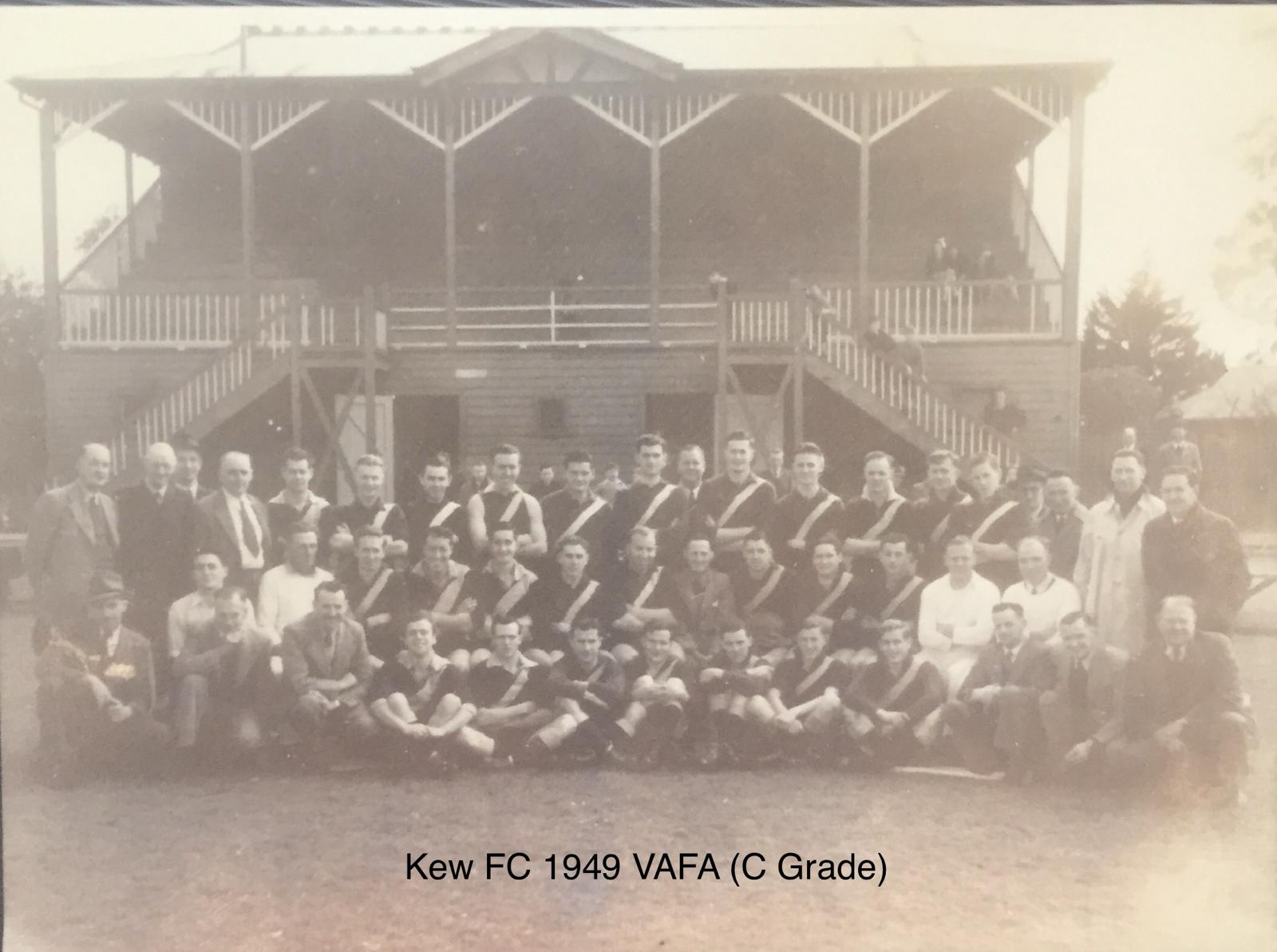
Season 1950 saw Alf Perrin and Jim Davidson swapping positions; Alf was now coach and Jim assistant and on the committee. It proved to be a bumper season with cricket like scores and eighteen (18) wins during the home and away rounds. A century score was recorded in all games bar two, both against State Savings Bank.
The first non-century score occurred in the away game at Brighton and the second in the Grand Final at Ivanhoe. A double century, and 183-point victory was scored against the hapless East Caulfield during the Round One victory.
After a strong semi final victory, the club’s first premiership in 16 years, and first in the VAFA, was achieved with a dominant victory over State Savings Bank – 11.14.80 to 2.10.22. With promotion to B grade achieved as C grade Premiers and Champions, and after 73 years across multiple football competitions, Kew had found its home in the VAFA, where it continues today!
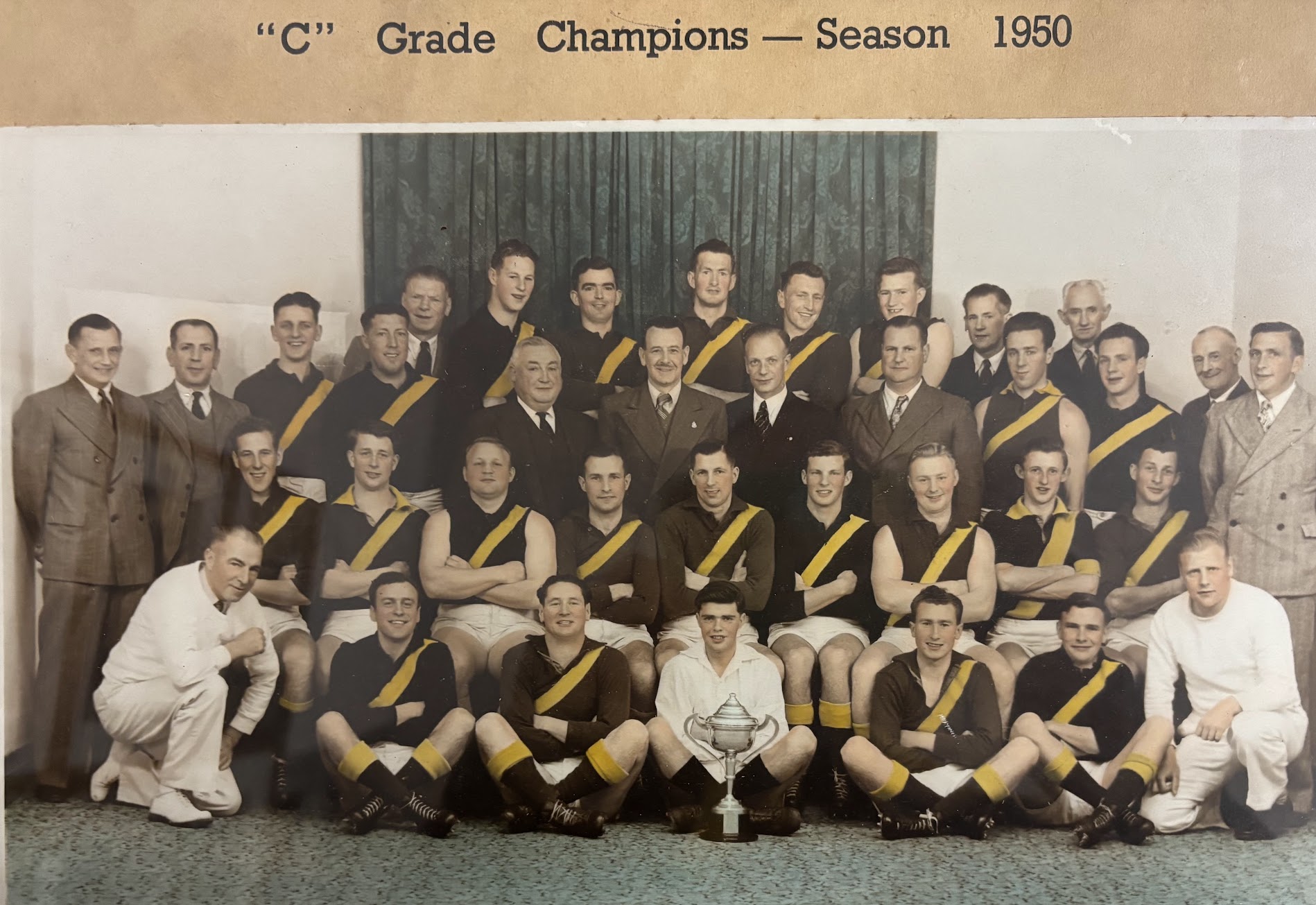
Following the 1950 C Grade Premiership, the rest of the 1950’s and 60’s was a successful time for Kew. Ray Martin, who had successfully Captain/Coached the club in 1941, returned in 1953 as non-playing coach with immediate impact, winning the 1953 B Grade flag and gaining entry to A Grade.
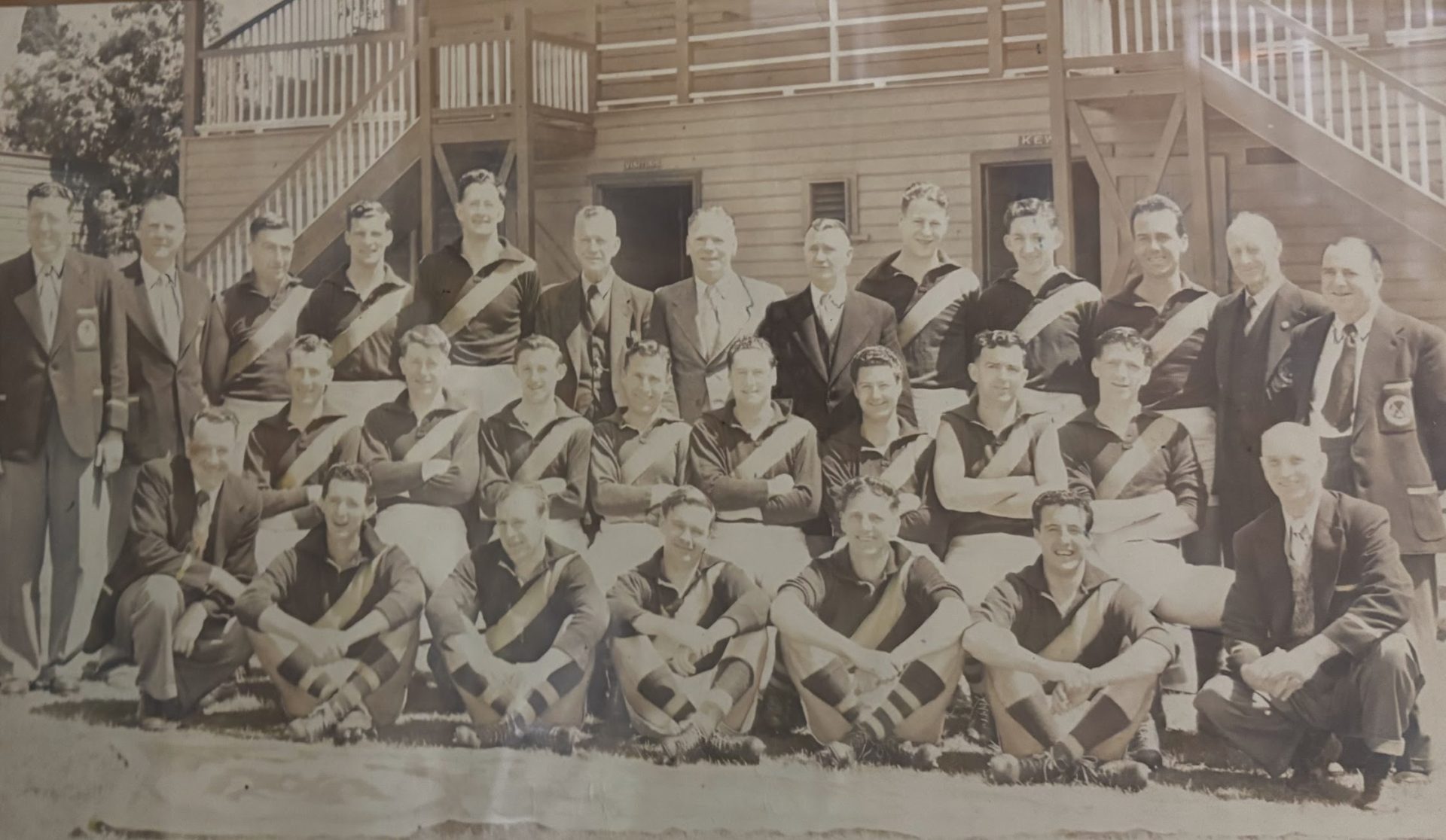
Unfortunately, the club was relegated to B Grade after three seasons. Ray continued coaching and finally built the team for re-entry to A Grade. Ray coached for 13 seasons before father time had caught up and club stalwart Frank Snell took over.
During his time, Ray added two further C Grade Premierships in 1962 and 1964.
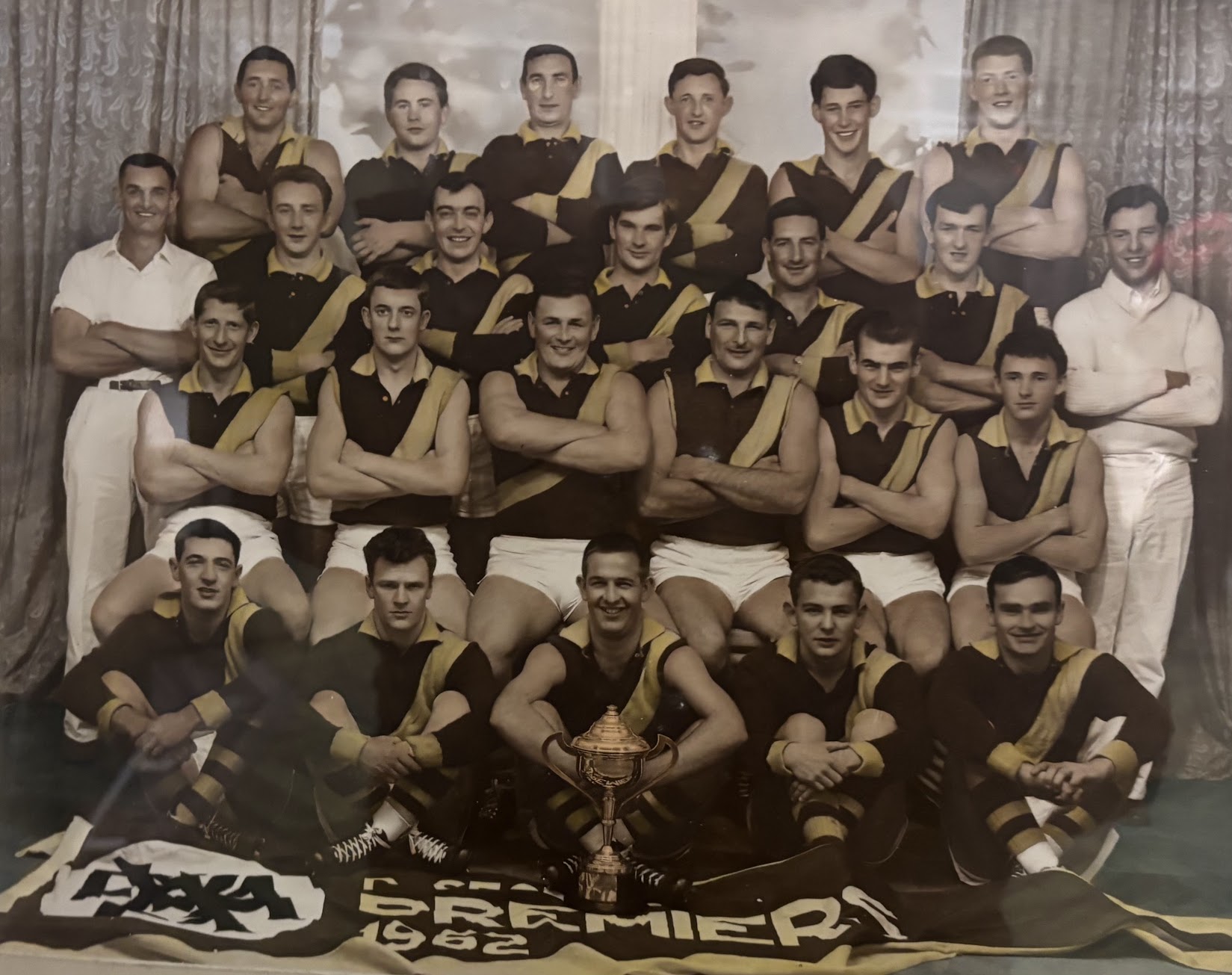
Then, one of the club’s finest moments would come in Frank Snell’s first season in charge in 1966, as just one year after being promoted Kew would win a second B Grade Premiership in a nail-biting 11-point contest over local district rivals Ivanhoe.
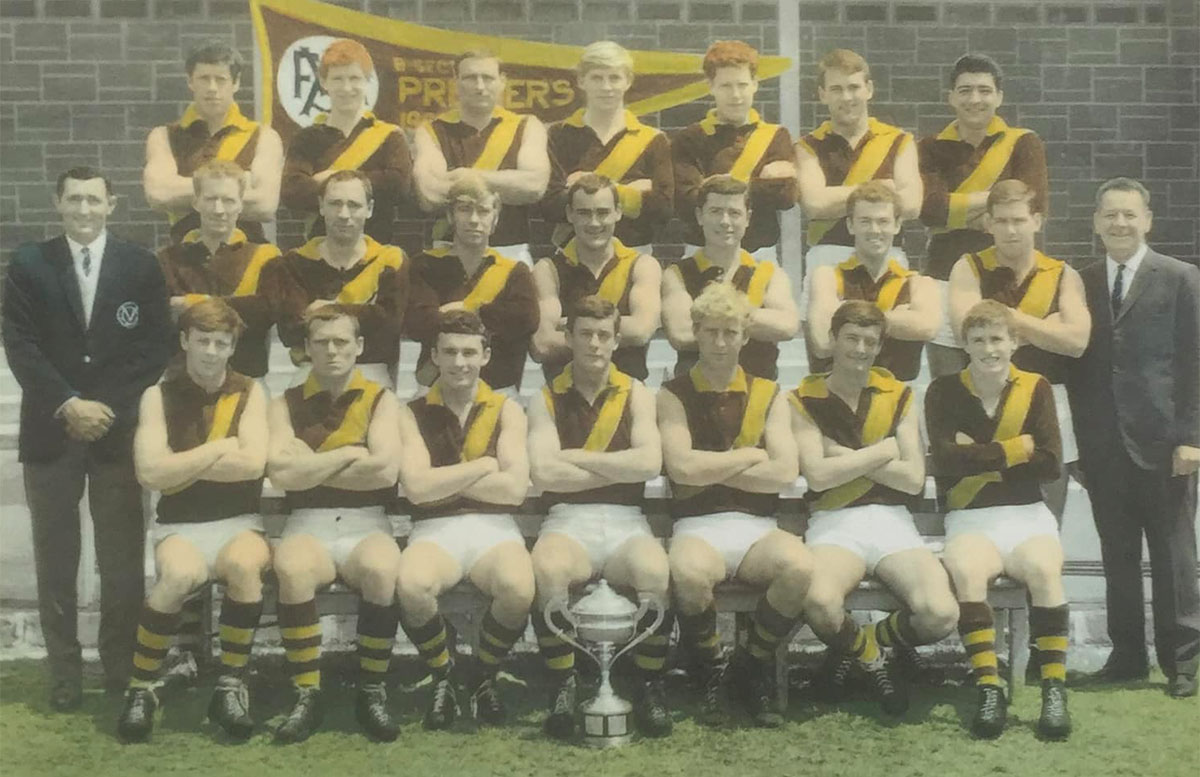
The 50’s and 60’s were a boom period for the club, with many champion players winning league and state honours. Alan ‘Mick’ Castle would win the C Grade Best & Fairest in the premiership season of 1950, whilst Noel Stokes, Vincent Crowe and Don Mullin would claim the B Grade honours in 1957, 1966 and 1969, respectively, and Donald ‘Mick’ Thompson and Frank Snell would win competition leading goal kicker awards in 1950 and 1962, respectively.
On top of this, Kew fielded 19 VAFA representatives through the 50s and 60s including All Australian Representatives Jack Caselt (1950), Len Brayley (1952/53/54), Raymond Martin (1958/60), Noel Stokes (1958) and Don Mullin (1969).
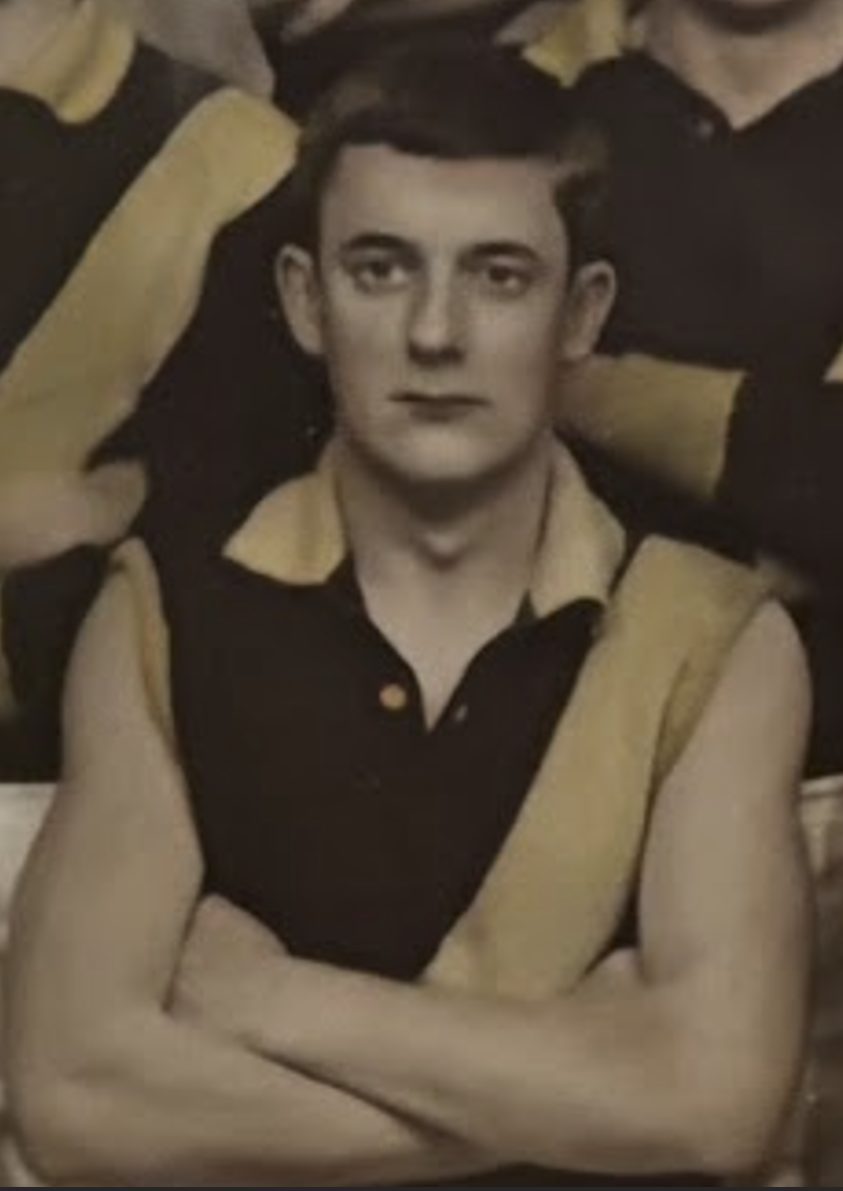
This time also saw the arrival of perhaps the club’s most distinguished player – John Fisher. John joined Kew FC as a teenager under the tutelage of Noel Stokes, and his talent was clear to see. John was a crucial piece of the 1962, 64 and 66 premierships; captaining 1964 and 66.
John represented the VAFA Big V side in 1965/66/67 including as vice-captain in 1966 and captain in 1967 – a year the VAFA would win the carnival – and 1967 would also see John take home the VAFA A Grade Best & Fairest (now named the JN Woodrow Medal). John is still the only men’s player in Kew history to win the A Grade Best & Fairest.
Such was his exemplary performance in his 160 games for Kew, John was recruited to Hawthorn in the VFL in 1968, and would spend three seasons playing at the game’s highest level. John would return to Kew as head coach for 1972 – 1976, and would then go on to coach the VAFA representative side in 1980-1982, 1986 and 1988, winning the carnival in 1982/86/88. John would be become a VAFA life member in 1989 and a VAFA Hall of Fame Legend in 2007. Truly a Kew and VAFA icon.
The early 1970’s were strong seasons in B Grade but with nothing to show for it, before the club would be relegated back to C Grade after 1975. During the decade the club would have a number of VAFA representatives, as Don Mullin, Bruce Smith, Barry Mitchell, and club icons Terry Hayes and Wayne Blay, would pull on the Big V guernsey. Following a few years of a coaching merry-go-round, in 1979 Terry Hayes himself, a long serving player and five-time best and fairest on top of being a Big V representative, took the Captain/Coaching reins with immediate effect.
The C Grade flag would be won by 38 points over St. Kilda C.B.O.C. (now part of Glen Eira Gryphons) and it was back to B Grade as a force. Unfortunately, little did we know that this would be the last time Kew FC would taste senior premiership success for over three decades.
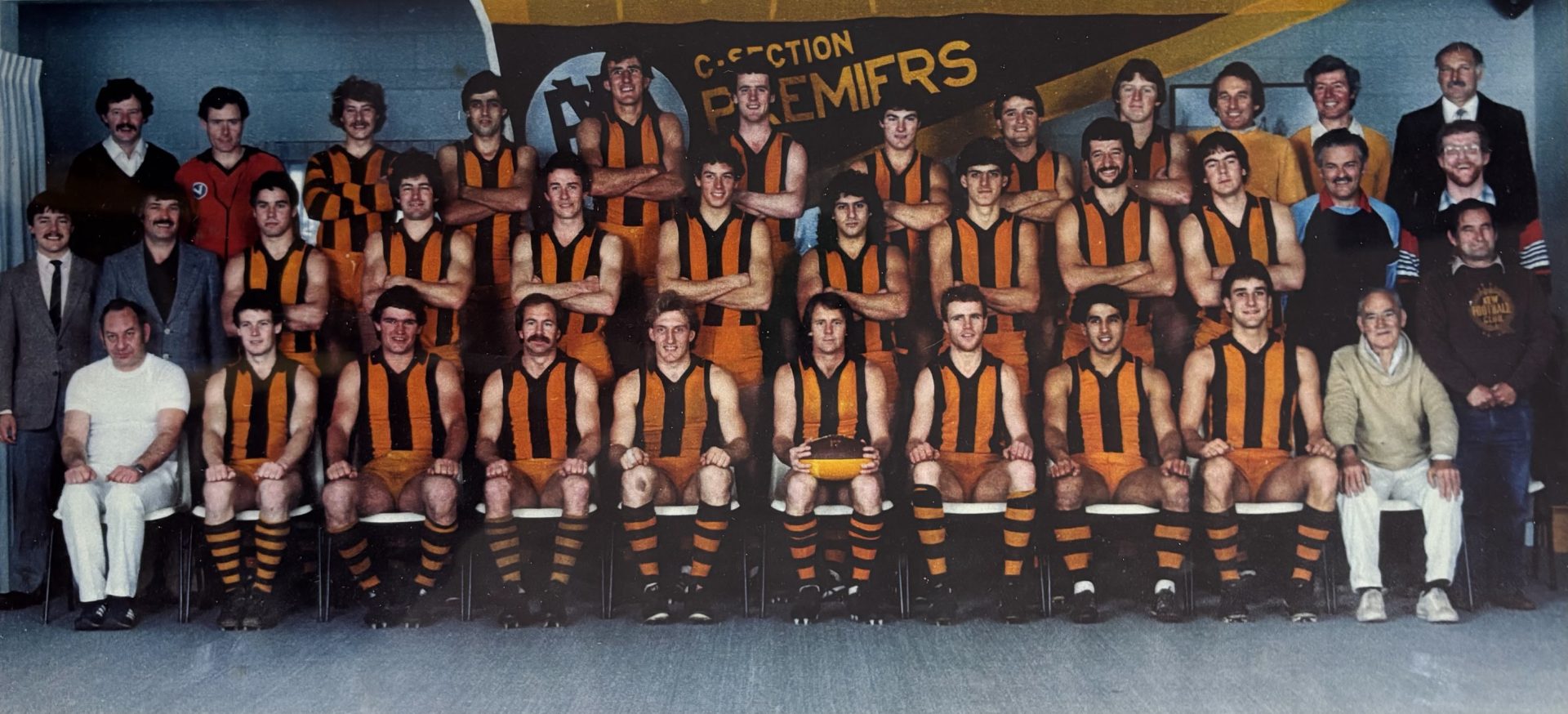
Similar to the preceding decade, Kew would spend the first half of the 1980’s competitive in B grade, before a relegation to C Grade after 1985.
Brett Burden would become Captain/Coach in 1987 with immediate effect, lifting Kew back to B Grade. Unfortunately, however, it would come off the back of a grand final loss to Monash Blues by 25 points.
1988 would prove to be ‘the one that got away’ as Kew took B Grade by storm, finishing on top of the ladder with 17 wins. A shock loss to Parkside in the second-semi final would be atoned for with a preliminary final victory over Therry CC (now Therry Penola). The ultimate glory was not to be, however, as Parkside would beat Kew in the grand final to claim the premiership. An errant 5 goals 18 behinds left Kew ruing a missed opportunity. The Reserves, however, would deliver some success for the 1988 season, with a premiership victory over Parkside, a reversal of the senior result.
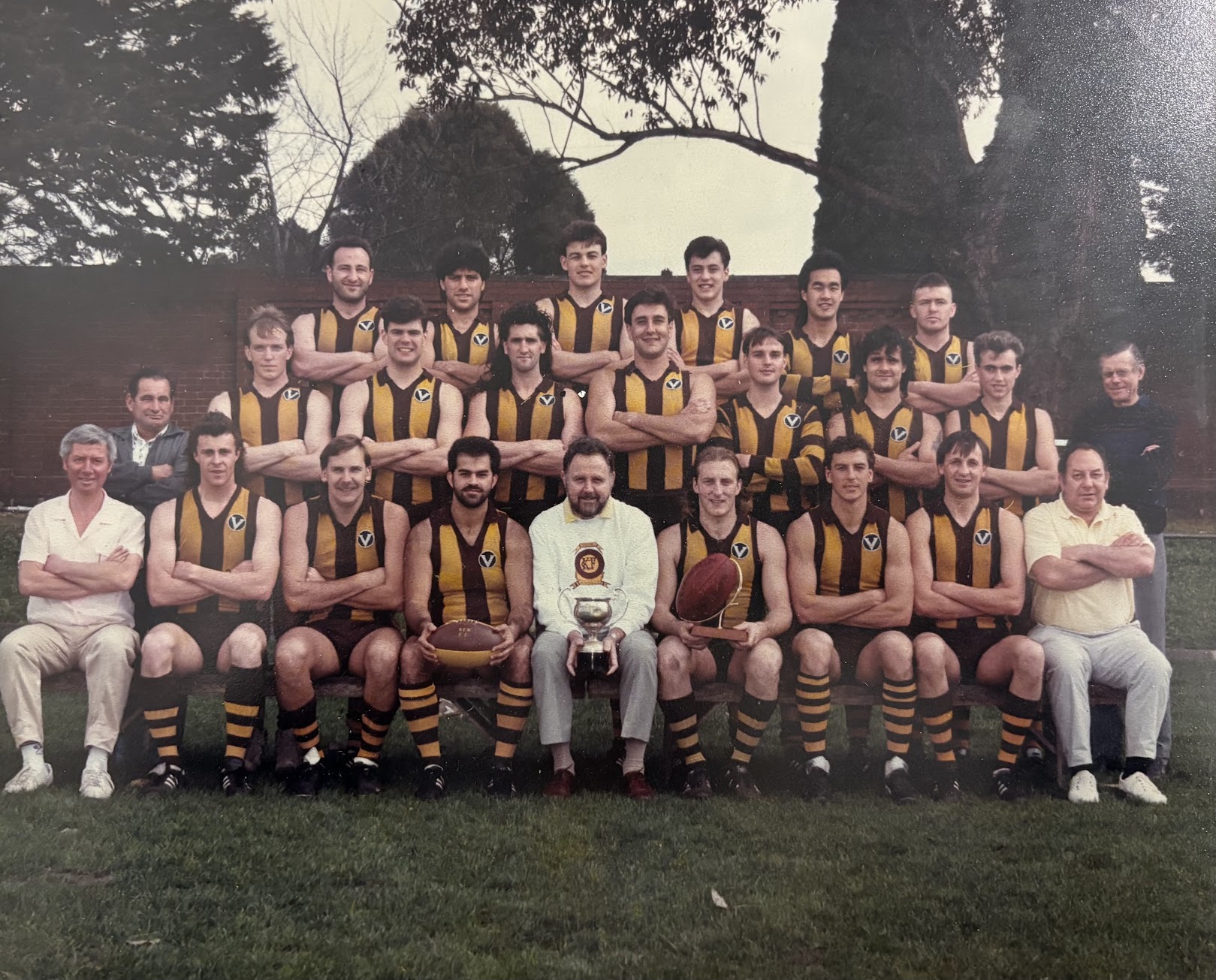
There were personal successes through the 80’s, though, with B Grade best and fairest’s won by Wayne Blay (1983) and Brett Burden (1988), and Joey Busuttil would take the C Grade medal in 1986. There were also a number of Big V representatives. Wayne Blay claimed 3 of his 6 rep honours in the early 80s, and Don Fletcher (1981) and Rocco Zerbi (1984) would each play for the Big V. Brett Burden collected four, including All Australian honours in 1988. Burden, along with Busuttil, Mark McColl and Matt Cavanagh would all represent the VAFA in 1987.
The 1990’s and 2000’s were without a doubt the toughest on-field period in the modern history of Kew FC. Starting in B Grade, a winless season in 1991 would see relegation back to C, before consecutive relegations in 1995 and 1996 would see the club drop to D and then the lowly E East Grade for 1997.
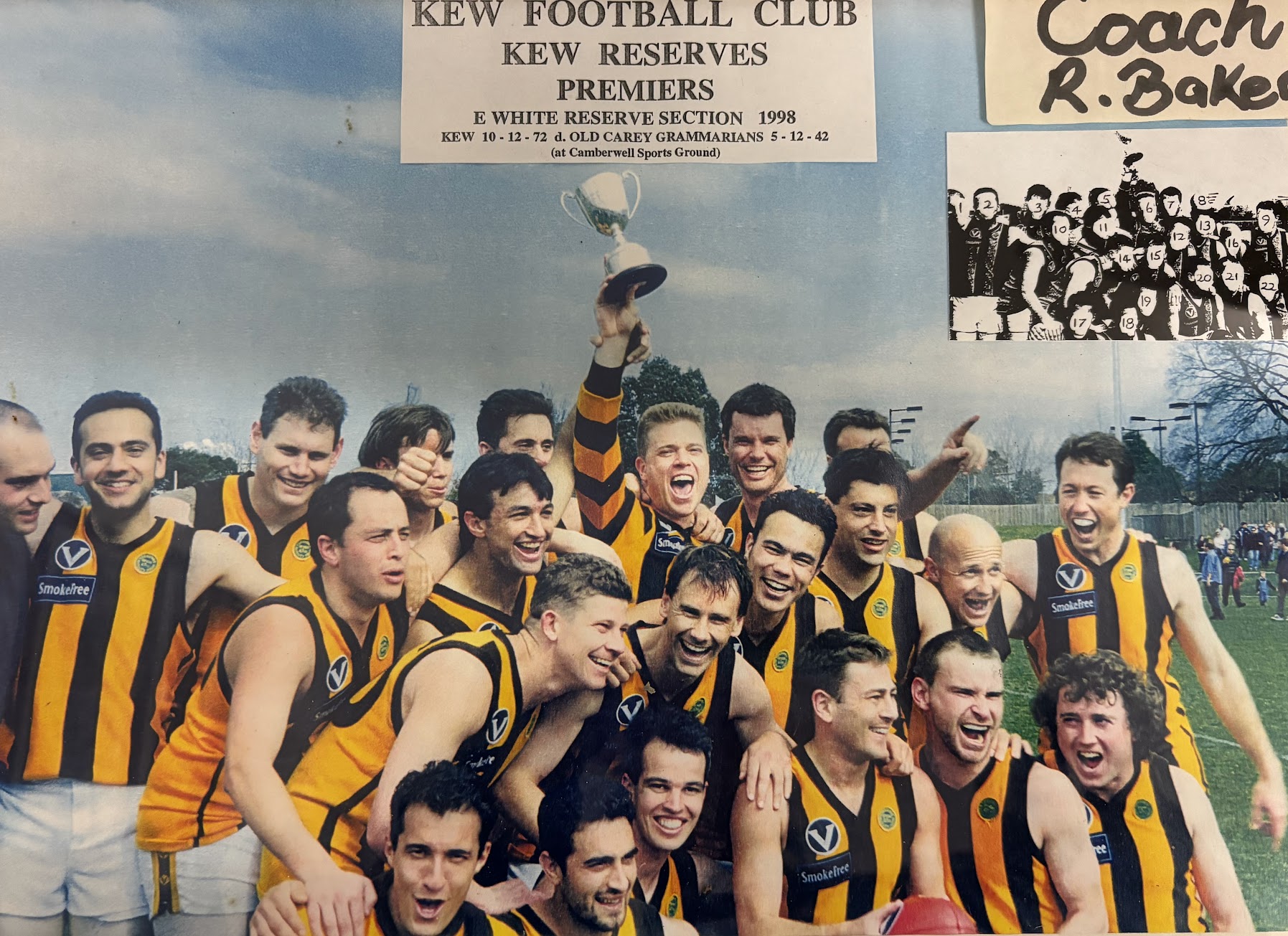
The club would steady, playing in Grand Finals in both 1997 (E East) and 1998 (E White), but losing both. The 1997 E East Grand Final was lost to Yarra Valley OB, before Kew returned to the Grand Final the following season, this time in E White, where it would fall short against Old Carey. The VAFA grading at the time meant only the premiers were promoted and thus Kew stayed in E / D2.
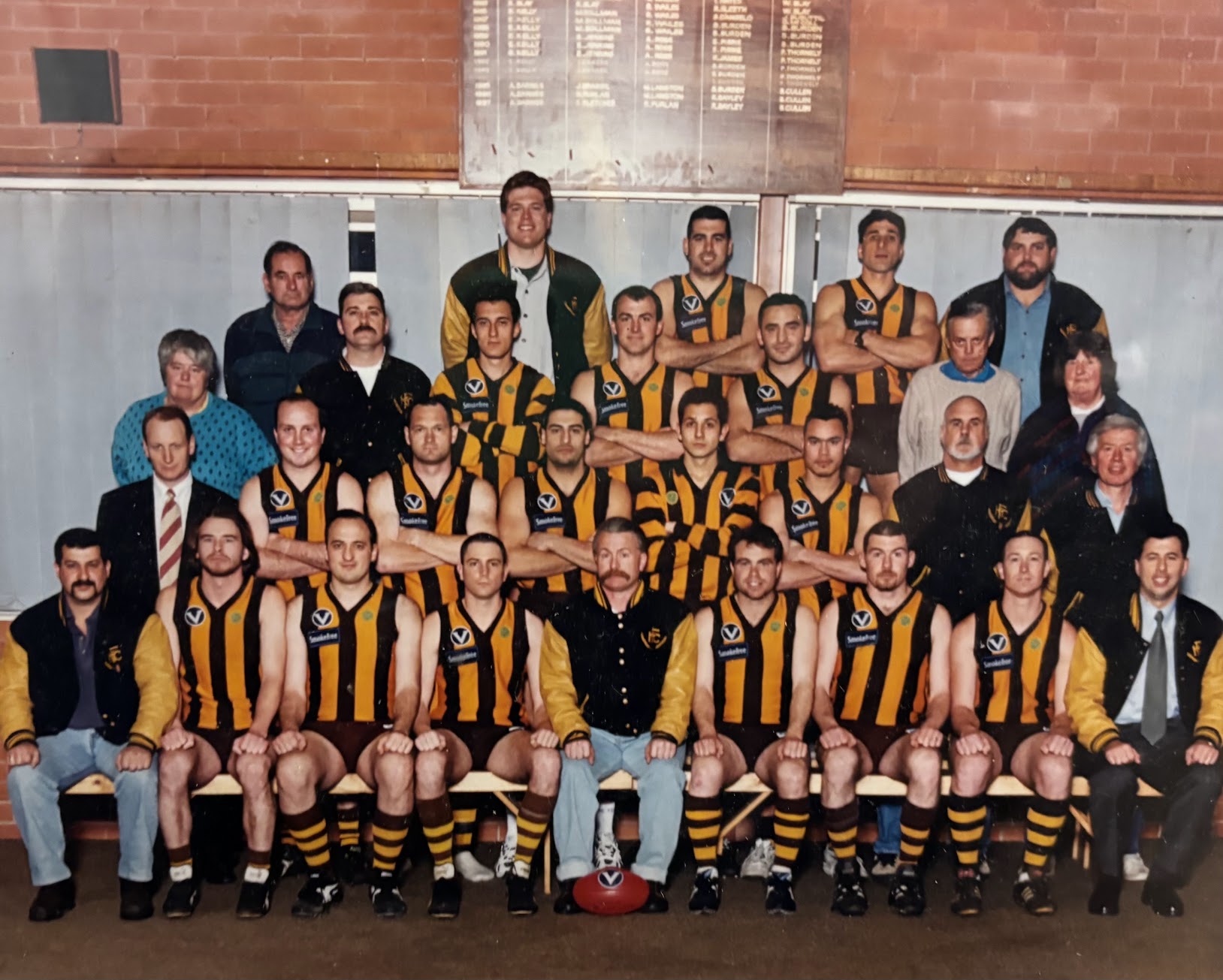
Another bottom finish in D2 in 2002 and 9th in D3, 2003 was enough to see the club drop to D4. After competing in A Grade in 1989, Kew had dropped to the bottom of the VAFA grades in 15 years.
The fall through the grades represented a dramatic change in fortunes for a club that had competed in A Grade only fifteen years earlier. Despite the difficult senior results, success across the Reserves, Club XVIII and Under 19s remained an important part of the club during this period, including Reserves premierships in 1996, 1998, 2004 and 2008, Club XVII flags in 1994 and 1997, and an Under 19s success in 2005.
In 2007, the club would merge with the local North Kew Football Club, who competed in the Southern Football League.
The VAFA landscape changed through the 1980’s and 90’s. District powerhouses like Kew, and other strong, suburban school boys’ clubs struggled to stay in the top grades as historically weaker old boys’ clubs that were aligned with the elite private schools got their act together, and the demographics of football in areas like Kew changed. Despite the tough times, there were plenty of great moments on and off the field, and the club was led ably by future life members like Brian Cullen and Nick Tinetti. Despite this, up and down in the cellar grades were no place for the once mighty Kew Football Club.
After a fortuitous promotion from Division 4 after 2009, Kew would finally be on the verge of turning it around. The arrival of Ian ‘Beaser’ Aitken in 2011 was the start of the club’s recovery. Aitken had playing experience at Carlton and St Kilda, as well as suburban coaching appointments to hone his skills, and the recovery and boom for Kew FC were about to start.
Despite modest returns in the first two seasons, including a semi-final exit in 2012, the building blocks were in place, and the club was ready to break through the following year.
In 2013, the club fielded an Under 18s side (nicknamed the Kew ‘Giants’) made up of Year 10, 11 and 12 students from Box Hill Senior Secondary College, where Ian Aitken was head coach of the football program, injecting considerable young talent into the club.
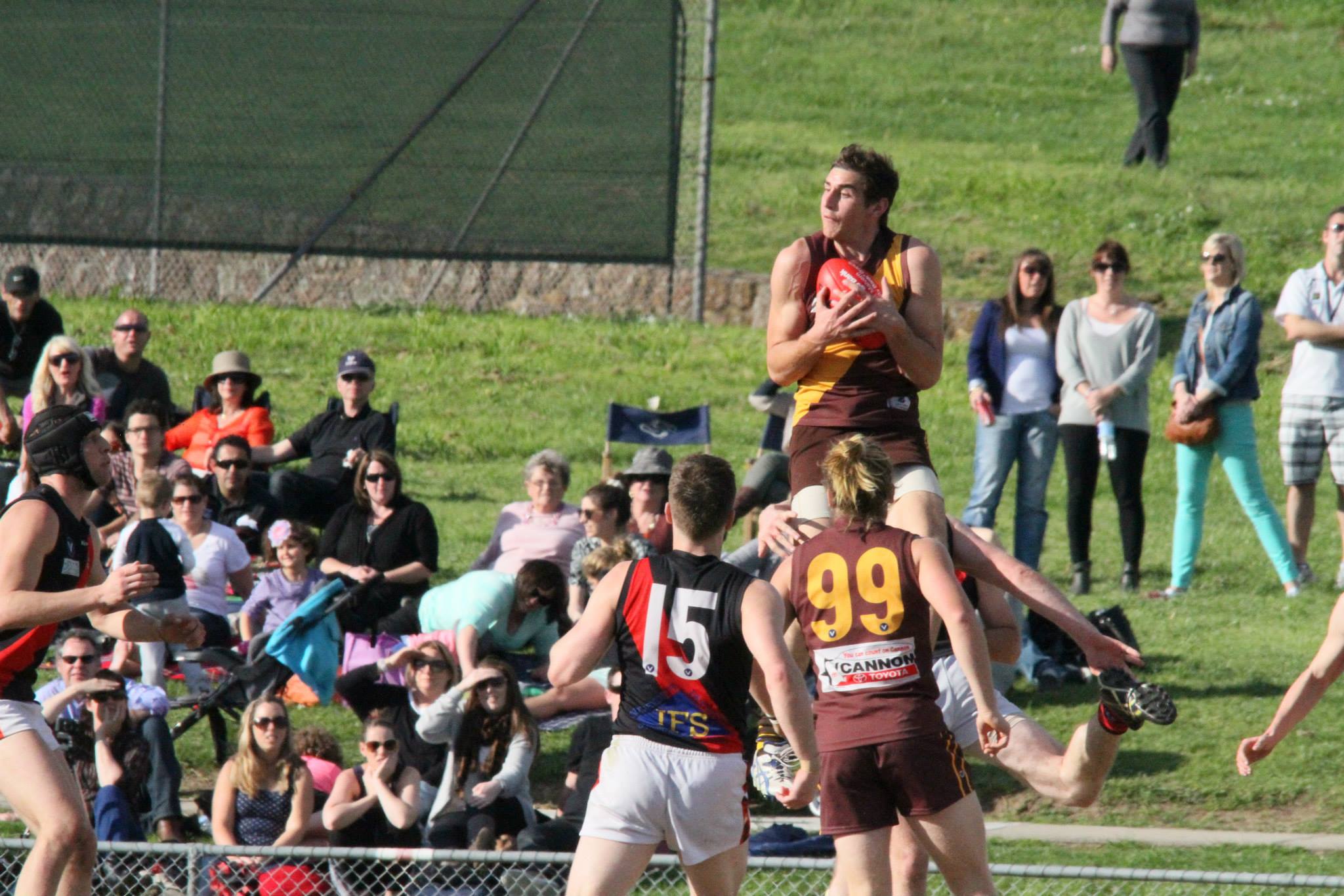
With the core of the senior team in place, a pathway of good young talent, and strong depth in the reserves, the mighty Kew Football Club would taste premiership success for the first time in 34 years, finishing on top of the ladder before defeating Elsternwick in the Division 3 Grand Final by 35 points. Kew Giants product Liam Kinsella, aged just 16, would win the best-on-ground medal.
It wasn’t just the senior side, either, as the Reserves would finish on top of the ladder, too, and win a nail-biting Grand Final classic over La Trobe University by one point. The U18 Giants capped their undefeated premiership season with a 78-point thrashing of Werribee Districts.
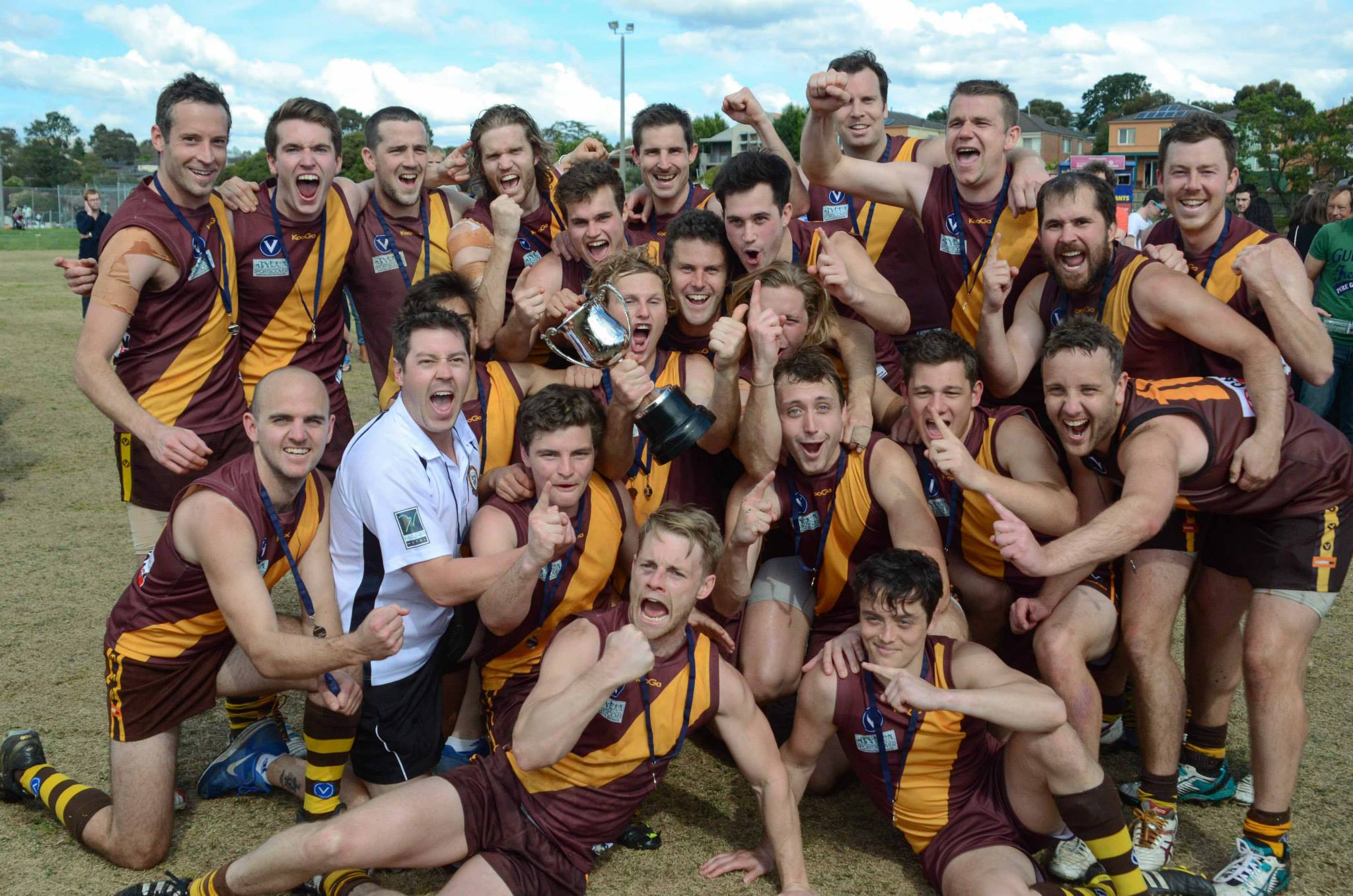
It was a special day at Ted Ajani Reserve, with three sides winning premierships, sending the club to Division 2 in the strongest position it had been in for over a decade.
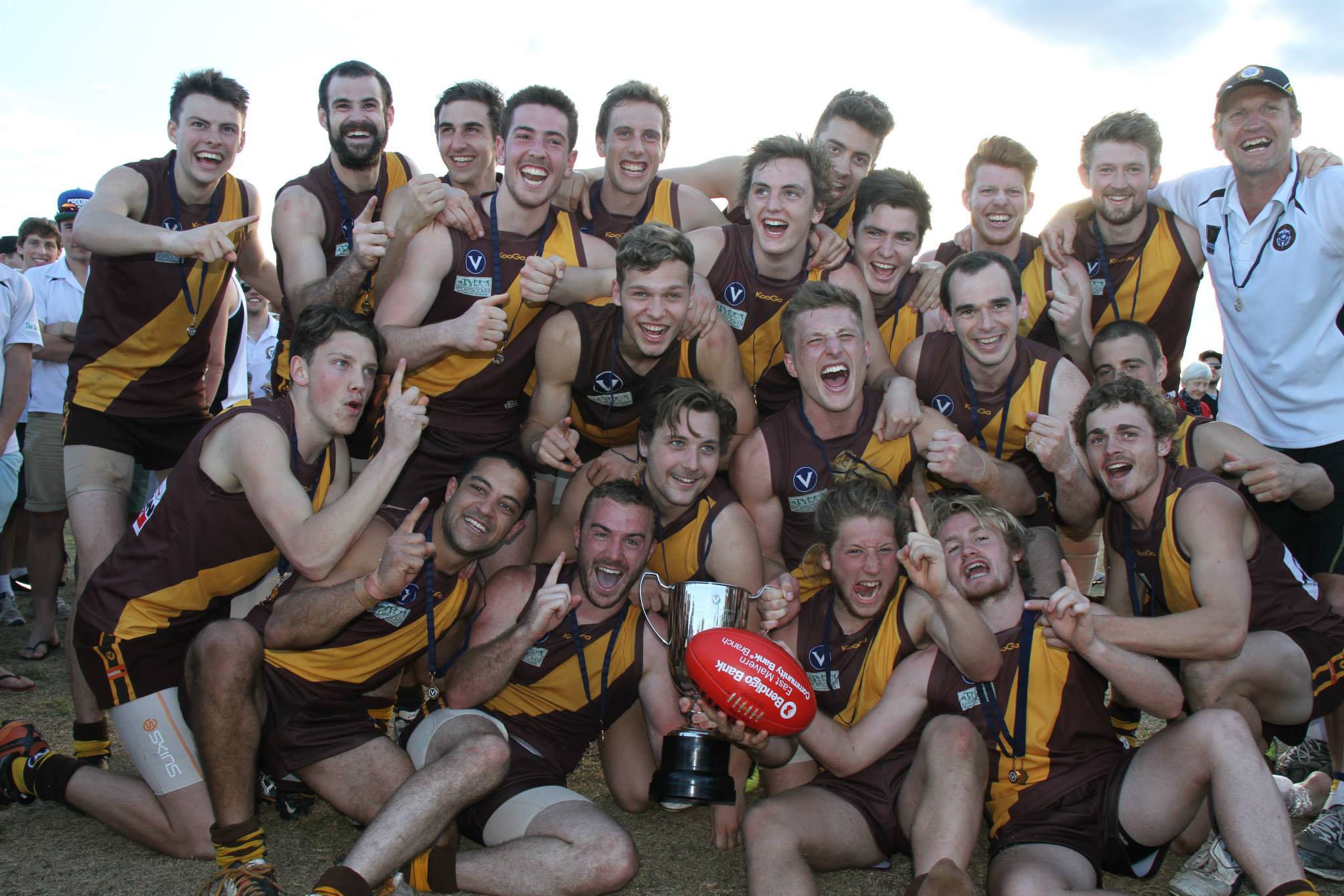
The 2014 Division 2 season would see the Bears win their first 10 games of the season, announcing themselves as premiership contenders, and ultimately finish the home-and-away season on top of the ladder. A poor loss to premiership threats St Mary's Salesian in the semi-final meant a sudden-death preliminary final against Eltham Old Collegians.
Despite trailing at three-quarter time, Kew would overrun the Turtles with a famous come-from-behind victory by 14 points, spearheaded by seven goals from Andrew Brazzale. If the preliminary final wasn’t close enough, the Grand Final the following week would test the collective heart rates of Kew supporters even more.
Having been outplayed by St Mary's in the second semi-final, coach Aitken knew that something special needed to change to give the boys the edge. As such, the game plan to be ‘Brutal’ – a play on the historic Kew moniker and line in our club song, the Brutal Browns/Bears – was concocted. The Bears were to play brutal, physical and unsociable football in order to gain the advantage, to which the players acquiesced with aplomb, and it would prove decisive.
A dominant first quarter saw the scoreline read 6.5 to 0.3 in favour of Kew. The Saints would not be denied, though, as they clawed their way back over the ensuing two-and-a-half quarters. Halfway through the last quarter, the margin was five points in favour of Kew as the season came to its thrilling crescendo.
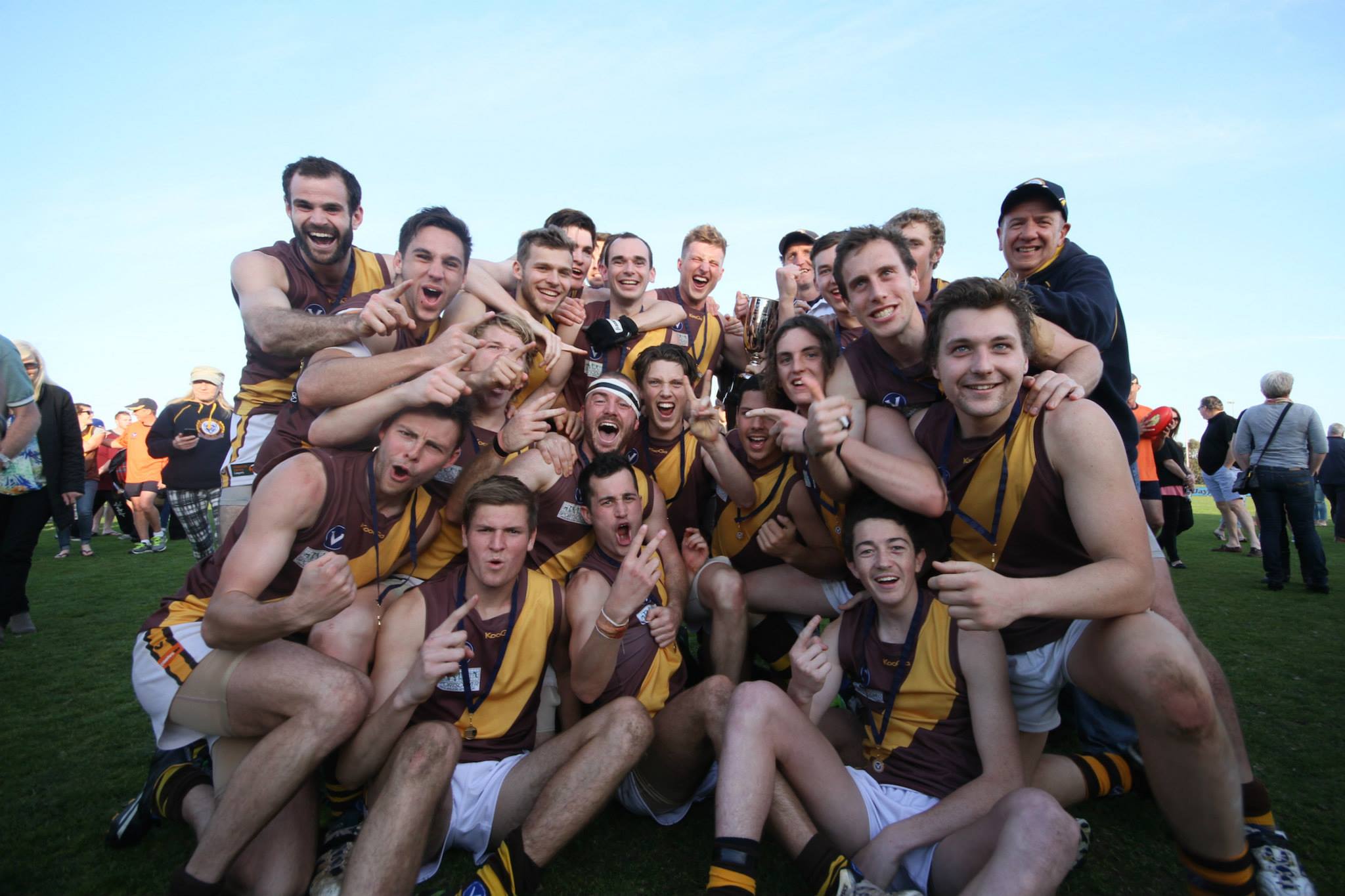
A final act of desperation from the Bears would see the ball land in the hands of youngster Kyle Margaritas, who would run in and slot the premiership-sealing goal to put Kew in front by 11 points with just nine seconds left.
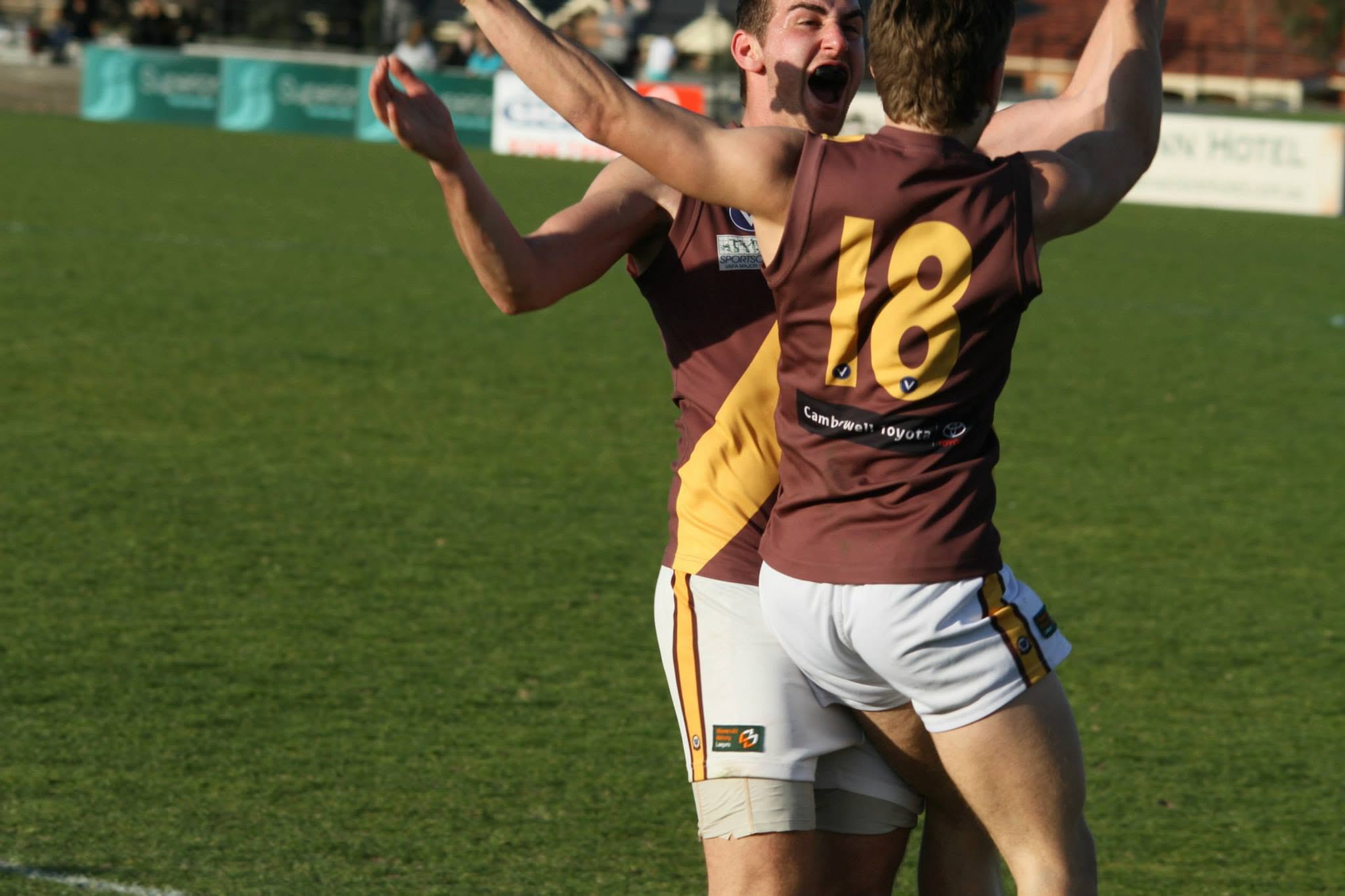
Kew became back-to-back premiers for the first time in over 80 years. Margaritas was fittingly awarded the best-on-ground medal.
This period would also see the journey of Women’s football at Kew begin, starting with a meeting at the Harp of Erin hotel in late 2013, where a small group of young women, who had enjoyed a few years of Youth Girls football at Kew Rovers, expressed a desire to want to continue playing together into adulthood. With no obvious pathway or home club, nor any rule book on how to actually get something off the ground, a plan was concocted to approach the local Kew Football Club about being the home of a senior women’s team. ‘The rest is history’ as they would say, as the Kew committee welcomed the initiative, and thus Kew would field a women’s football side for the first time in 2014.
A dream that started with one fledgling junior girls’ team quickly blossomed into two senior teams, albeit with very tight numbers, that would compete in the Victorian Women’s Football League (VFWL). Jeff Hooper, who had coached the Youth Girls team at Kew Rovers, was named inaugural coach of the ‘Division 2’ side, whilst Courtney Donnan (née Morath), the driving force behind the inception of the women’s program, would coach the ‘Division 5’ side. The sides would be named the Kew Giants, using the moniker and colours from the previous seasons Under 18 Men’s side in the VAFA.
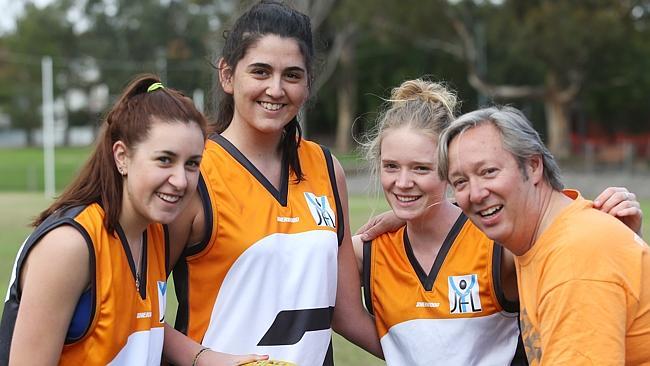
Despite this momentum, the early days were still very tough. Training numbers were in the single digits, and the defeats in opening rounds were in the triple digits. To make things more difficult, travel for away games included North Geelong, Redan, Sunbury, Seaford and Mordialloc. It was certainly emblematic of women’s football competition at the time. After 7 rounds, the decision was made to continue the season with just one side, so the Division 2 side was removed and the season played out in Division 5 under the one side.
Having been winless for those 7 rounds, in Round 8, with the two sides combined and competing in Division 5, Kew Giants Women would taste victory for the first time with a 73-point win over Brunswick Renegades. Following the winless start, Kew would go on to win its last 5 games to finish 4th on the ladder, achieving finals in its inaugural season. A 55-point win over Melbourne Uni in the first semi, followed by a 38-point win over Brunswick Renegades saw the team qualify for the Grand Final! Unfortunately, the fairytale wasn’t to be, as ladder-leaders Seaford would defeat Kew by 13 points at Coburg City Oval. Steph De Bortoli & Jess Burger would captain the side in this first season, and do a fantastic job laying the platform for those that would come after.
The landscape of women’s football in 2014 wouldn’t recognise itself today. The early Kew women’s footballers went without the luxury of waiting for the opportunity to present itself. Teething issues came in droves, as the side navigated equal opportunity against the grain of just about every feature of club football that was familiar and comfortable.
In spite of this, the positive results in the back half of 2014 meant that enough momentum was built for the team to continue the following season. The Giants moniker and colours would be dropped, with the team adopting the traditional ‘Bears’ name and jumper. The competition would change again; this time Kew would play in Division 3. Ben Forrest and Antony Forato took over as coaches, with Steph De Bortoli again co-captaining, this time alongside Amber McEwin. A strong season would see the side finish 2nd after the home and away season. In the first final, Kew would cause the upset of the season with a 2-point victory over powerhouse (and previously undefeated) Endeavour Hills, and with it qualify for a second consecutive Grand Final. Deer Park would also upset Endeavour Hills, setting up a grand final show down with the Bears. Unfortunately, Deer Park would prove too strong, winning by 20 points.
Not to be satisfied with the success of back-to-back flags, the venture into Division 1 in 2015 for the Men’s side started with another 12 straight victories. The most memorable of those was the Round 10 clash with Ormond. Both clubs had started the season 9–0 and met in one of the most anticipated Division 1 matches of all time. An enormous crowd flocked to E.E. Gunn Reserve to see Kew demolish the Monders by 63 points.
A late-season fade-out would see Kew finish second on the ladder behind Ormond, with champion full-forward Andrew Brazzale leading the competition goal-kicking with 68 goals, as well as earning Big V representative honours.
Disaster would strike on the eve of finals, however, as Brazzale and young key forward Rob Maibaum would both be coward-punched by an opposition player in Round 17, suffering a broken nose and jaw respectively. Given the loss of over 100 goals in the form of those two players, Kew were written off heading into the second semi-final against Ormond at Elsternwick Park.
The spirit of the group shone through, as without its two spearheads, Kew would defeat the Monders by 27 points in a sodden affair, qualifying for the 2015 Grand Final and, with it, earning promotion to Premier C for 2016. Ormond would atone for its loss by winning the preliminary final, setting the scene for a final showdown between the two district clubs, who had clearly been the best two sides in the competition.
Despite their injuries, stars Brazzale and Maibaum would return for the Grand Final, providing an added boost to a team already brimming with confidence. With a strong northerly blowing at Coburg City Oval, Ormond won the toss and kicked with it. The first quarter was a masterclass in defensive football, as the Bears restricted Ormond to 1.5 and kicked 1.0 themselves, the goal coming from none other than Andrew Brazzale himself – an astounding 45-metre drop punt from the boundary into the breeze!
Kew took control in the second quarter on the back of Jack Delbridge, Liam Kinsella and Zac Jones, slamming on six goals to none to open up a 32-point half-time lead. With the memories of St Mary's comeback 12 months earlier squarely front of mind, the Bears defended for their lives in the third quarter and, despite six goals from Ormond, added a crucial 2.3 into the howling gale to hold a 10-point lead at three-quarter time.
After a tight opening 10 minutes in the last, the Monders’ resistance was broken, as a procession of Kew goals put the result beyond doubt. The premiership win was punctuated by an iconic goal from back-pocket Michael Henderson, who collected an errant ball at half-forward, danced around an Ormond opponent with a baulk and slotted the sealer. The final siren sounded with Kew 30 points in front.
An historic three-peat had been achieved, climbing the grades from Division 3 to Premier C in just three seasons. Captain and centre half-back Michael Cochrane was sublime, completely blanketing his opposing number, whilst Kyle Margaritas would make it back-to-back best-on-ground medals with a vintage performance on the wing, having been inexplicably left alone to roam free.
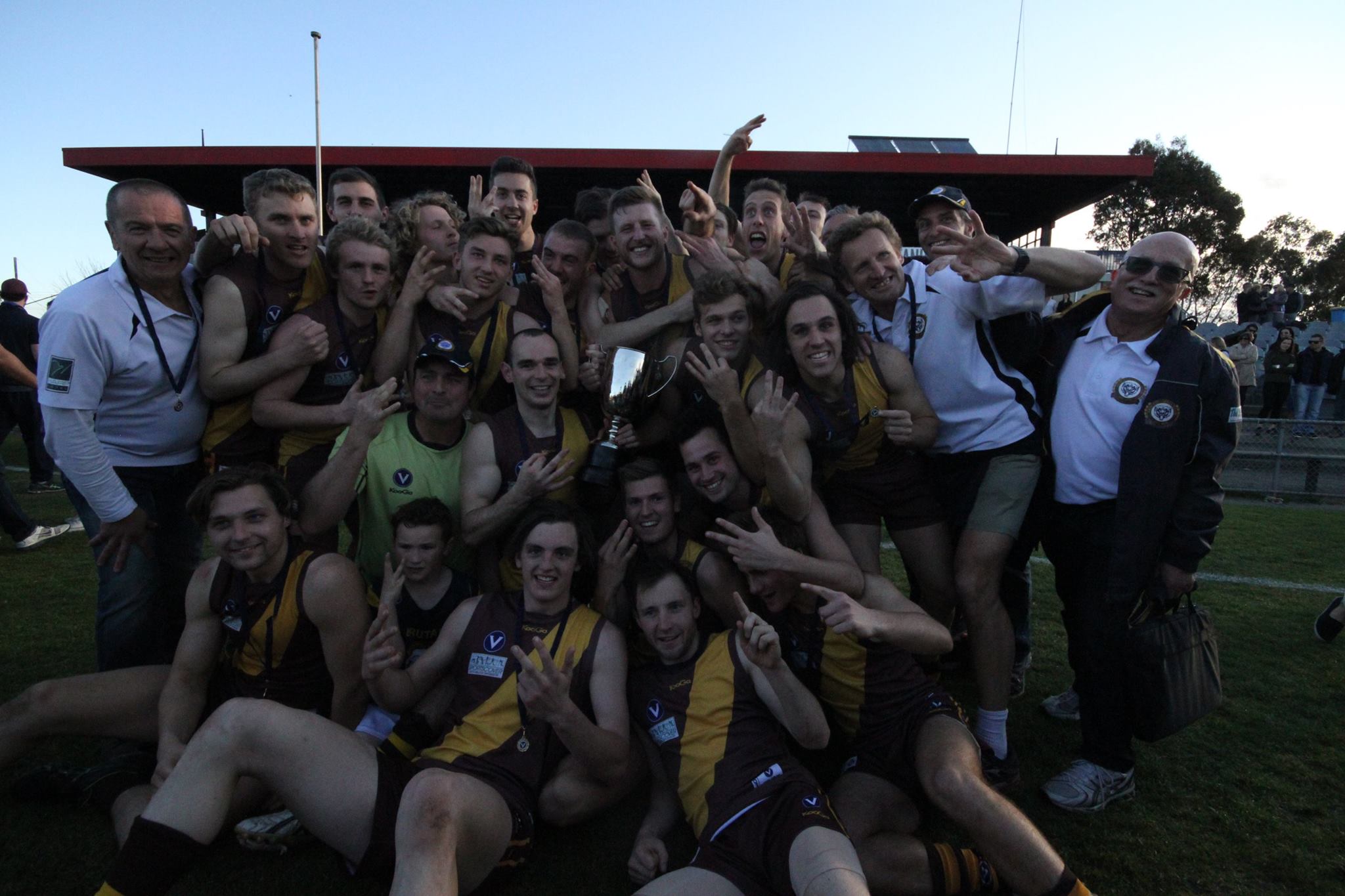
And so, Kew’s most successful period in 50 years (since the three premierships between 1962 and 1966) had been achieved. The club had been lifted from the doldrums by Aitken and his men, whilst making VAFA history in the process. It was on to Premier C in 2016 with wind in the Bear’s sails!
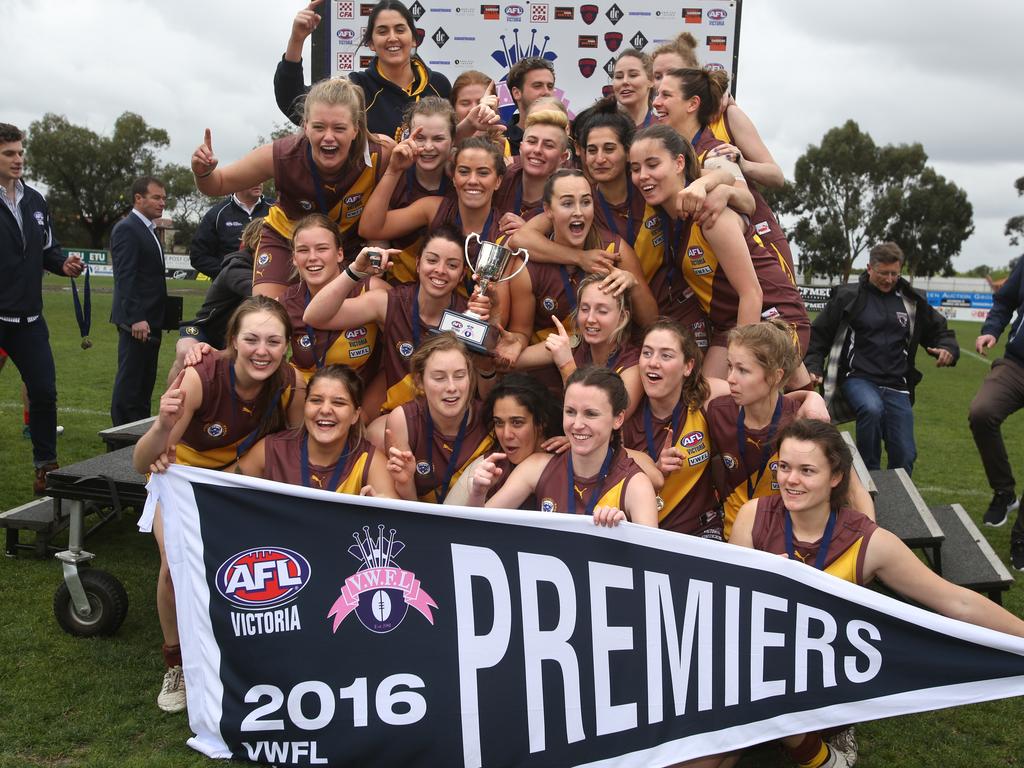
2016 would be a year to remember for the fledgling women’s program. Ben Forrest continued as coach, as the team were this time placed in Division 1 of the VWFL. Motivated by two grand final defeats, and with a side filled with strong players on every line, Kew would run the table, going undefeated in the home and away season and finishing on top. A 40-point win over Pascoe Vale in the second semi-final meant a third consecutive Grand Final appearance was achieved. Third time would truly be the charm, as on a sodden Sunday morning at Coburg City Oval, Kew would defeat Darebin Falcons by 19 points to win its first ever Women’s Premiership! Sarah McKenna was adjudged best on ground, but it truly was a team effort. Such was the strength of the side; four players finished in the top 10 in the competition best and fairest count – Gabby Mahoney the highest placed in 2nd.
Kew has been lucky enough to be home to a number of champion women’s players in its 13-year history of Women’s football. Early days it was Steph De Bortoli, who would be drafted to Melbourne in the inaugural AFLW draft in 2016, along with the likes of Amber McEwin, Selina Wilmot and Sarah McKenna. The Harding sisters – Mikaela and Issy – were the backbone of the senior side for years. Both had played together at Kew Rovers before their Kew senior careers. Mikaela is the winner of a record four best and fairest’s, whilst Issy also won one. Their father Greg was a long-time volunteer, helper and coach in the women’s program. Tara Donnan was another constant across the program as both a player and coach, for many years. In recent years Lily Barr has been the leader of women’s football at Kew – captaining for 5 seasons and representing the VAFA in interleague competition. Dakota Villiva won two best and fairest’s for Kew as well as the VAFA Women’s Premier Best and Fairest. All in all, seven women have played 100 games for Kew – Mik and Issy Harding, Lily Barr, Selina Wilmot, Tara Donnan, Louise Potts and Krystal Shaw, and twelve have pulled on the Big V in the VAFA representative games.
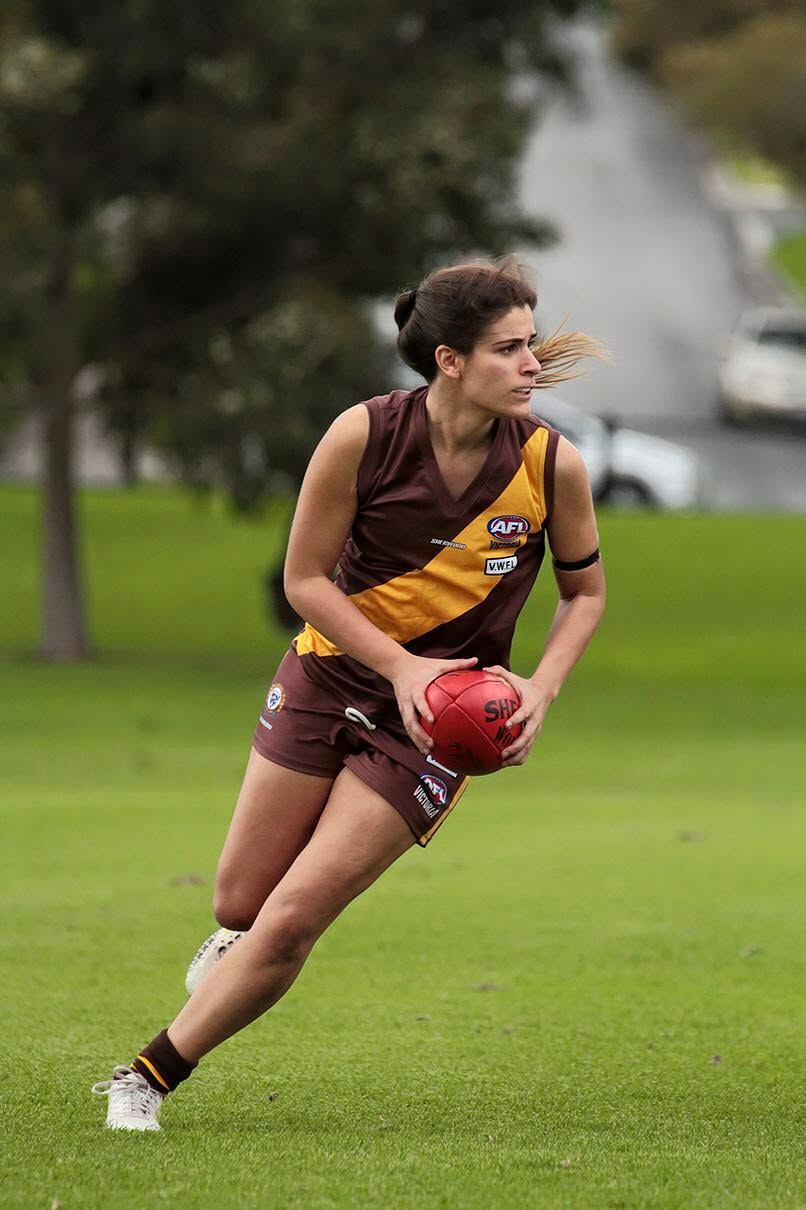
All of this would not have been possible without the immense work of Courtney Donnan. Courtney was a founding member and player of the Kew women’s teams, and her legacy shines through in the women’s players that represent Kew FC week in week out today. Courtney spent 10 years organising and running women’s football at Kew, including three seasons as club secretary. Her contribution to Kew was rewarded with Life Membership in 2024.
During this 2014-2016 period, women’s football had boomed across Victoria and Australia more broadly, in large part driven by the AFL’s introduction of a women’s competition for 2017, following series of exhibition matches in the preceding three seasons. Coinciding with the inaugural season of the AFL national women’s competition, multiple local leagues commenced Women’s competitions for season 2017. Having been an established club, Kew had its choice of leagues and decided on the Northern Football League (NFLW). Having been established as a destination club for women’s players, Kew would field two sides in the new NFLW. The NFLW was a strong competition, with the Senior side competing in Division 1 under new coach Theo Vlahos, and the Reserves side in Division 2. Despite a strong season, a 5th placed finish meant an elimination final against Melbourne Uni, which would ultimately be lost. The Reserves lost the semi-final to Darebin.
Following the success of the Men’s three-peat, Ian Aitken would depart the club to take up a coaching position at Northern Blues VFL (Carlton’s affiliate at the time). After a successful start in Premier C in 2016, the club would be relegated back to Division 1 after a disappointing season in 2017. With a tranche of retirements, departures, and serious injuries to a large cohort of the three-peat side, and with no Under 19’s to fall back on, the club had to again regroup in Division 1.
With Theo Vlahos continuing at the helm of the Women’s side, another new era would commence as the side moved to the VAFA competition, to fully align with the Men’s sides. Entering in the top flight Premier & Premier Reserves competitions, another top 4 finish for the seniors would ultimately result in another lost final to Melbourne Uni. A 6th place finish in 2019 meant the side missed finals for the first time.
Ian Aitken would return as Men’s Senior coach in 2019, immediately taking the team in to contention, but after a strong start to the home and away season, a late season fade out and disappointing semi-final loss to Peninsula Old Boys meant the side walked away empty handed. The Men’s Reserves and Under 19s (newly reformed) would both win premierships in 2019.
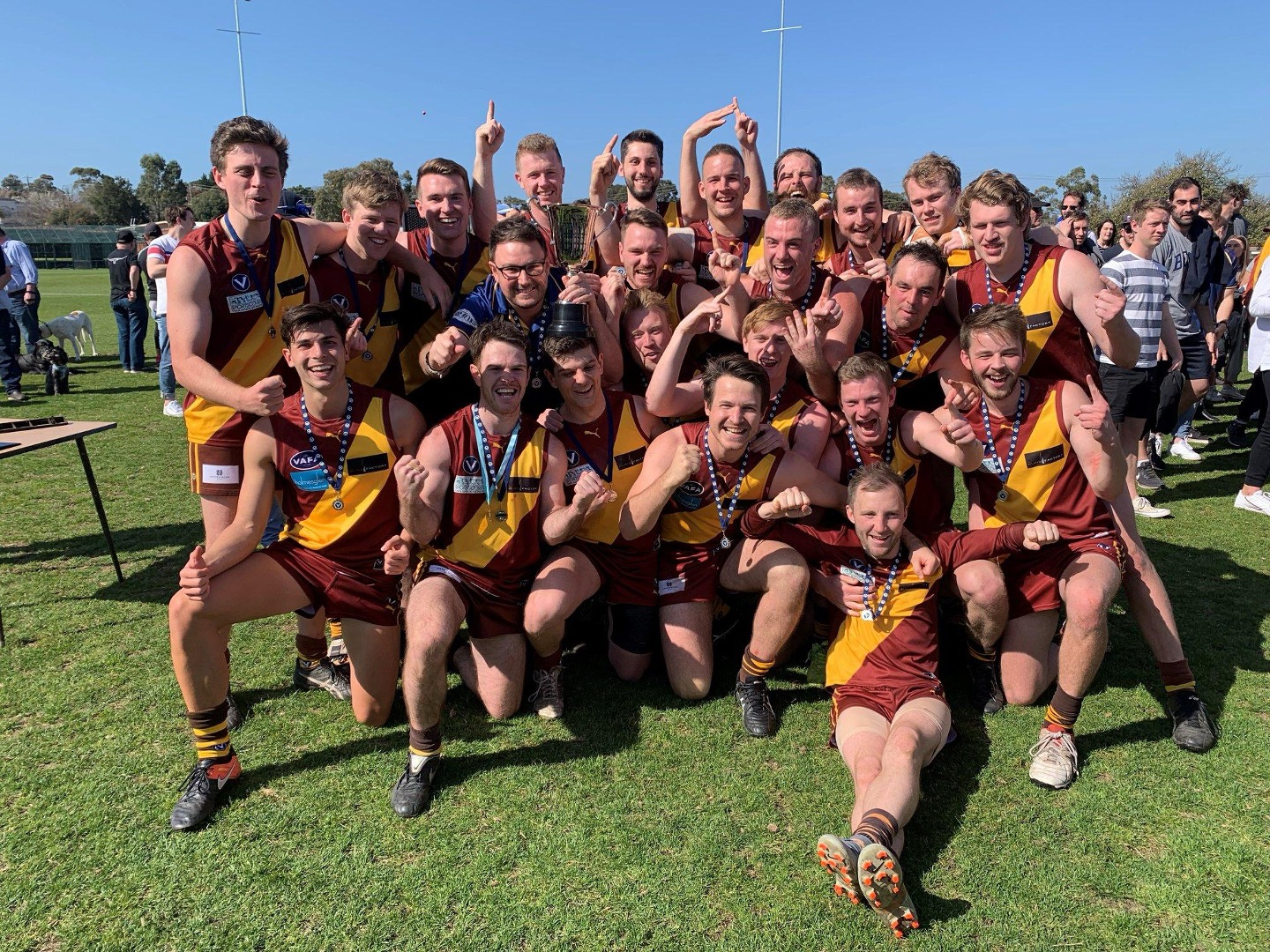
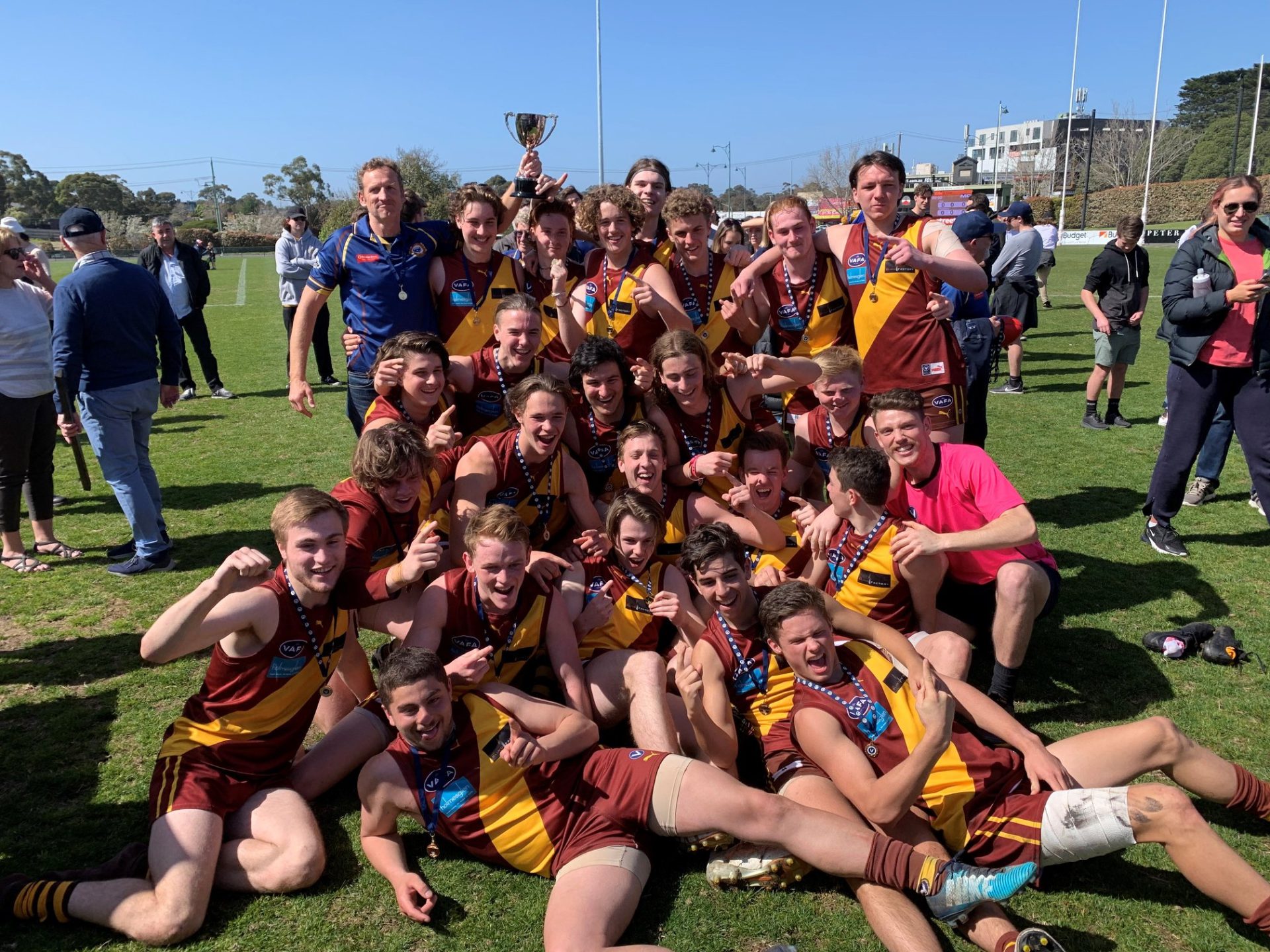
The global Covid-19 pandemic would ruin the next two years, with the men’s side left wondering ‘what could have been’ in both 2020 and 2021 with an extremely strong side. Theo Vlahos would continue to coach the women’s side, before finishing after the cancelled 2021 season.
2022 would see the return of 2016 premiership player, inaugural co-captain and Collingwood AFLW operations boss Jess Burger as the Senior Coach, which injected a huge amount of energy in to the program. The side, captained by champion on-baller Lily Barr, would have an excellent season, finishing second on the ladder behind St. Kevins. The second semi-final would see Kew defeat the Saints, qualifying for the Premier Grand Final. The dose wasn’t able to be repeated, however, as St. Kevins would run over the top of the Bears by 23 points to claim the premiership.
The men’s seniors would again have a very strong home and away season, finishing 2nd on the ladder. Unfortunately, it was another finals fade-out, with losses to PEGS in the second semi-final and Old Camberwell in the preliminary final meaning Kew would remain in Division 1. It was a tough pill to swallow, as Kew boasted an exceptionally strong young side, including current Carlton AFL player Cooper Lord (17 at the time), amongst a host of other young players who would go on to play VFL or top-level local football. Such was the standard of the top 3 sides that season, that following promotion, in 2023, PEGS would finish second in Premier C, whilst Old Camberwell would finish third and make the Grand Final, earning successive promotions to Premier B.
Jess Burger would continue as women’s coach for season 2023 – the 10th Year of Women’s Football at Kew. The size and enthusiasm of the Women’s squad demanded expansion to include a Thirds side, which couldn’t have come at a better time for the club. It was a mighty year on field. All three sides would finish on top of the ladder and qualify for Grand Finals. The Thirds, in its first season, unfortunately lost a heartbreaker to West Brunswick by 4 points. The Senior side came in to the Grand Final rematch against St Kevins as warm favourites, but alas the Saints would replicate the previous year’s encounter, winning by 25 points.
Despite the disappointment of the Senior side’s defeat, there was Reserves side, who claimed a famous victory by 1 point after a passage of play that will go down in Kew FC folklore. Trailing by 5 points deep in the last quarter, a desperate end-to-end play would result in a Tenille Nash mark 20m out just seconds before the final siren. With ice in her veins, ‘T’ would go back and slot the match-winner after the siren, giving Kew its first premiership in VAFA women’s competition, and second women’s flag overall.
Aitken would finish up with the men’s side after a disappointing season 2023, where the team missed finals. There was success, though, with the Men’s Reserves winning another flag in Division 1 in 2023, having lost an agonising grand final the previous season by 1 point.
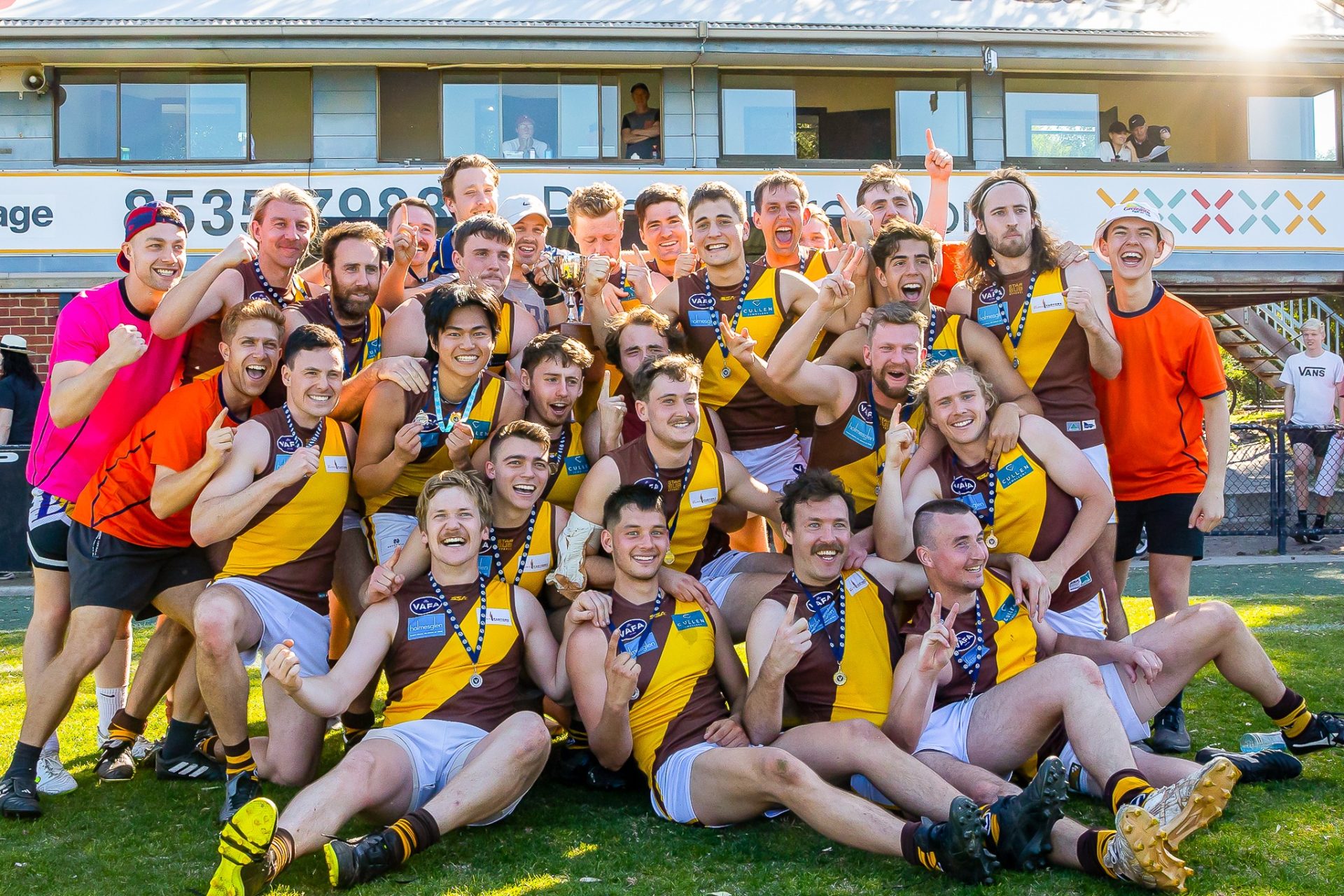
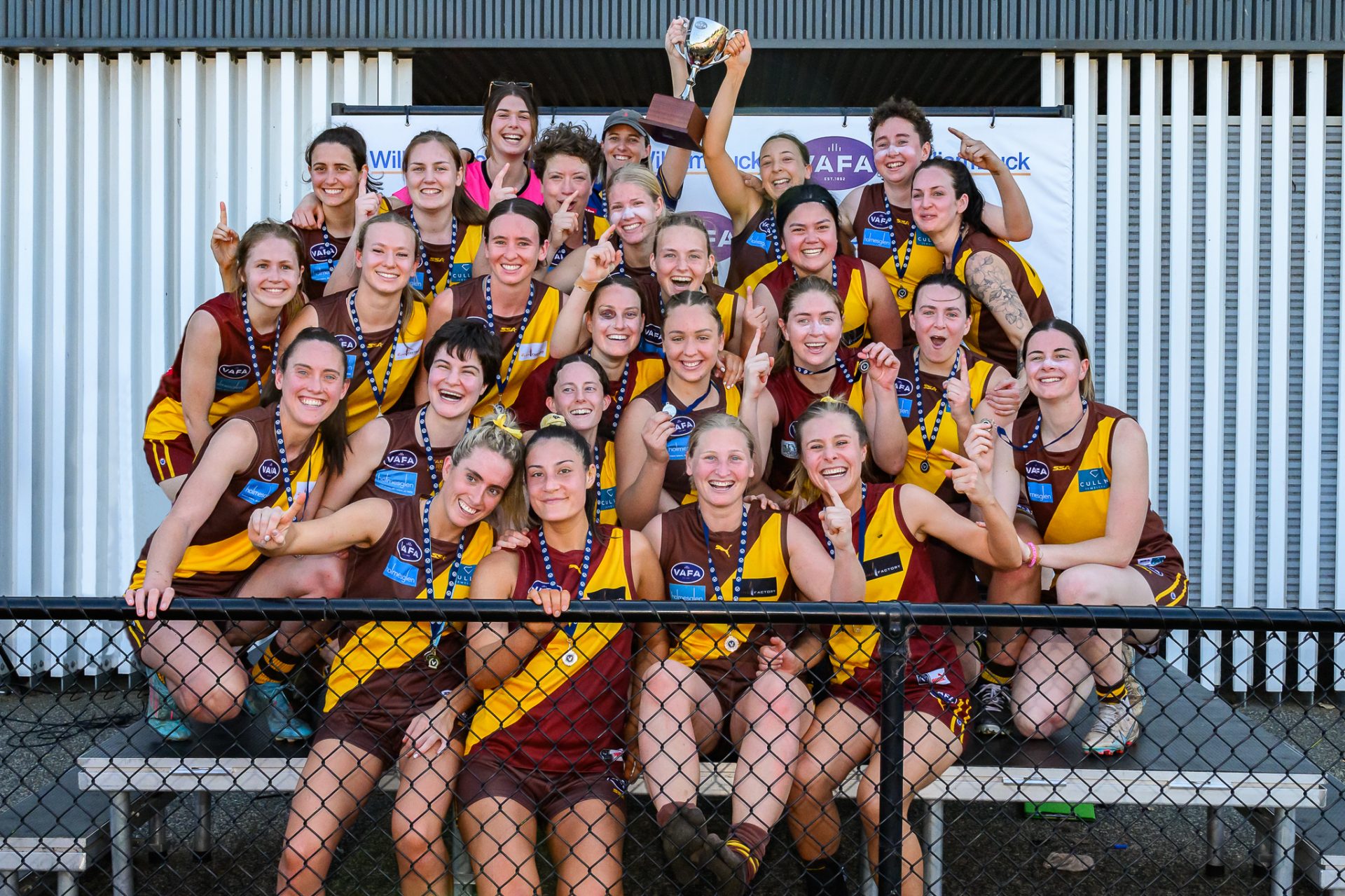
In thirteen years, the club has grown and developed a program that feels like home. With inclusion and enjoyment at the forefront, the Bears can be proud to have been at the forefront of women’s football in Victoria. Consider what our 2014 female footballers might have thought a “gender equal future” would look like at the Bear Cave, all these years down the track. Women make up nearly half of the Club Committee, including three out of five positions on the Executive Committee.
It isn’t now as it’s always been. Female-cut uniforms, Saturday fixtures, Club-wide training sessions, sanitary bins and changed language. We recognise the significant off-field progress that has fostered our on-field success, culminating in five Grand Final appearances including a VWFL Division 1 Premiership in 2016. Much of this success is owed to those with the courage to have a go in the formative years, laying the platform for the successful program we see today.
2024 would see Jess Burger step down owing to her commitments at Collingwood, with Reserves Premiership Coach Emily Avery taking over. Em Avery would steer the club through two seasons, both resulting in semi-final losses, before departing the club to take up a role at Gold Coast Suns in its Girls’ Academy. Mannie Di Parsia, who had previously coached the Kew Under 19’s men’s side, would take over as head coach for season 2026.
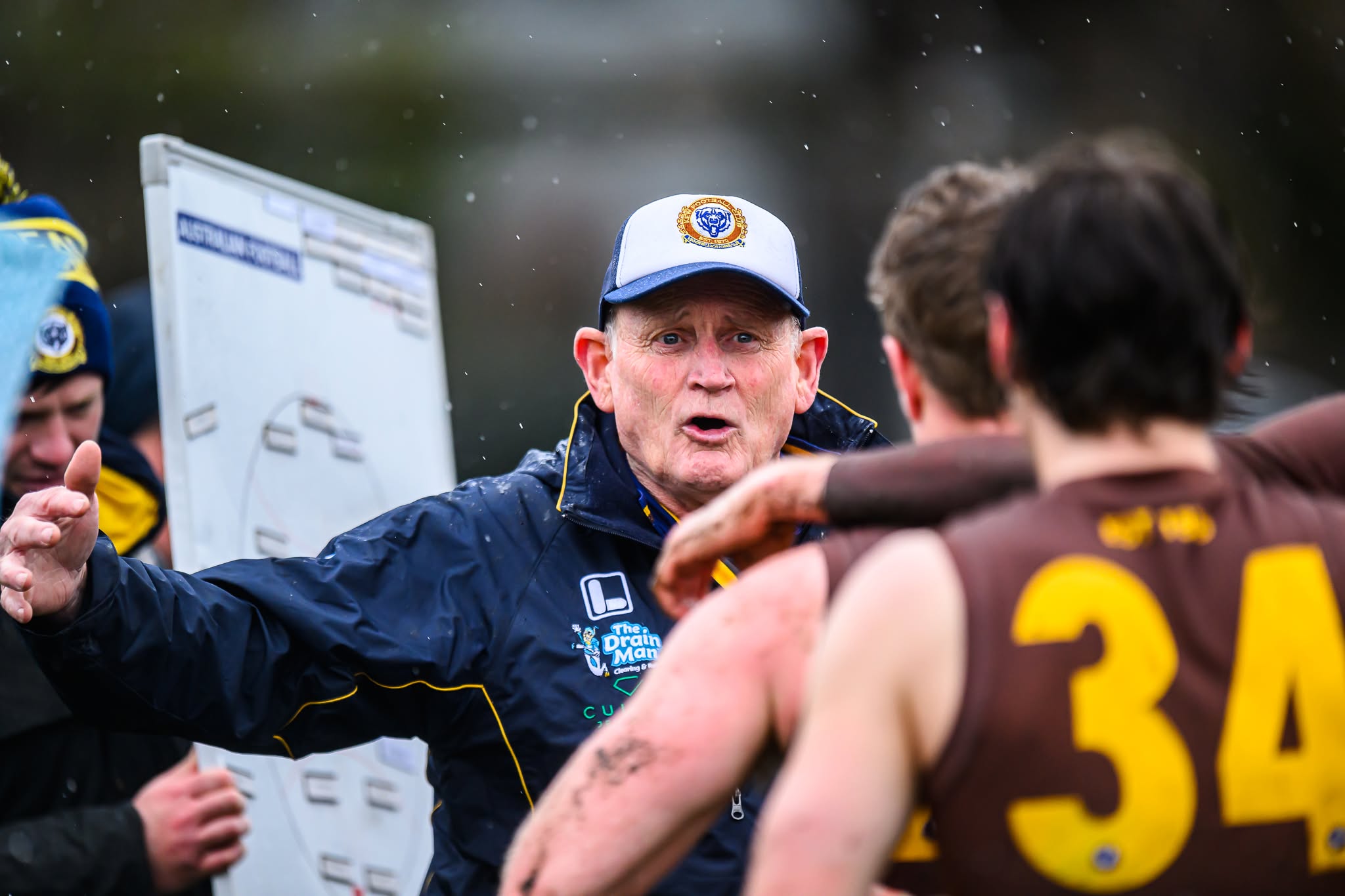
Former Collingwood VFL player and long-time local coaching icon Bryan ‘Jack’ Cole, would be appointed men’s head coach for the 2024 season, a role in which he continues today. The Under 19’s program, which had again fallen off as a result of the Covid-19 pandemic, was brought back in 2024 on the back of the graduating Kew Comets Youth Boys side. The Under 19’s continue to compete today, adding valuable young talent to the senior ranks. Kew FC is proud of its relationship with our official feeder Kew Comets, and our unofficial feeder, neighbouring Kew Rovers, who continue to provide the next generation of Kew FC senior footballers.
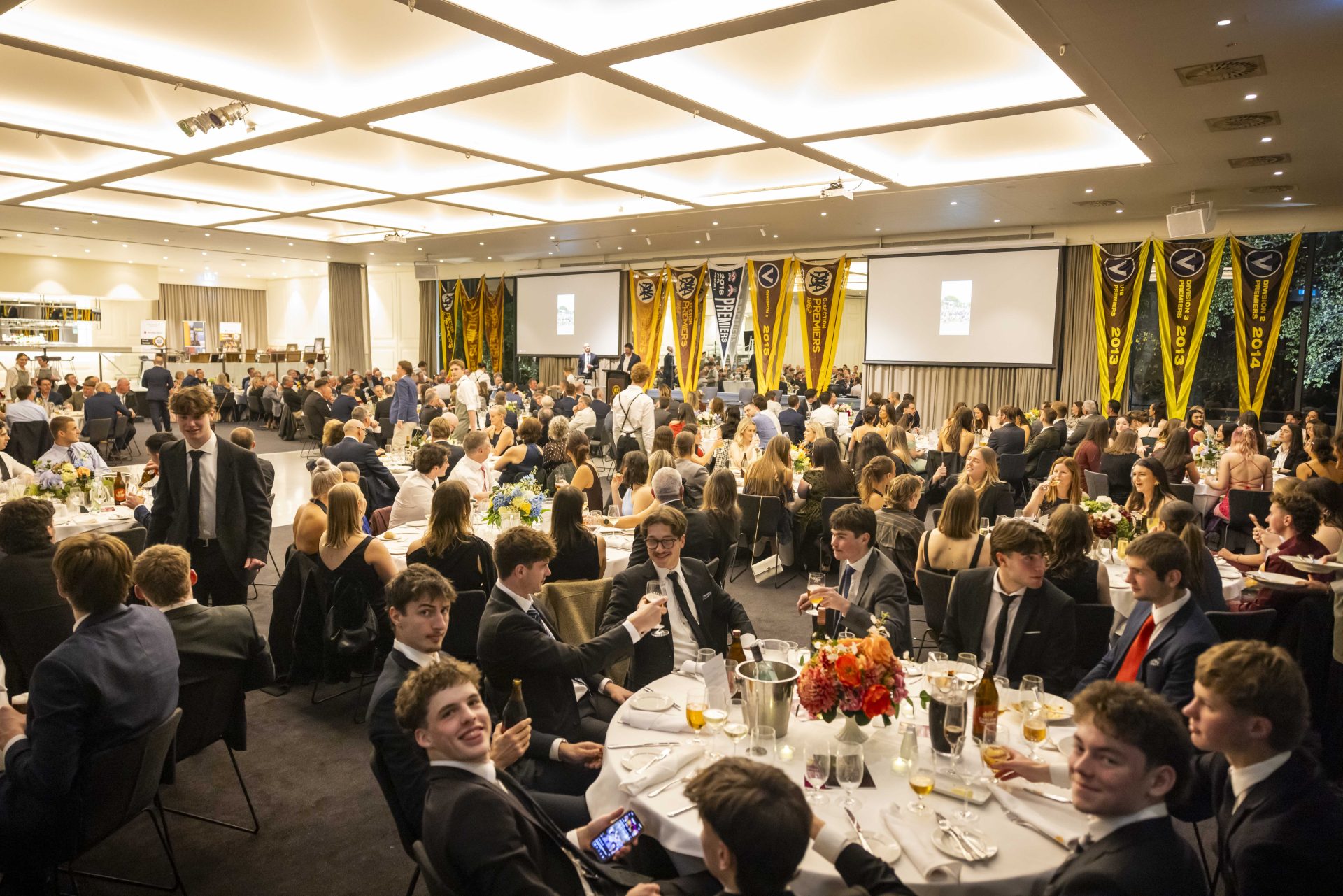
In 2026, Kew Football Club celebrates its 150th Year since inception – a feat only a few local football clubs today can boast. The club celebrated this momentous occasion with a special gala dinner, which was attended by over 300 current and past players, supporters, members, family and friends. Kew continues to field six sides – three men’s, under 19’s and two women’s – with well over 200 registered players! Kew has a formidable history as a genuine community club, and we look forward to the successes of the next 150 years!