The story of North Kew Football Club began in 1937, when a group of local boys formed the North Kew Rovers and entered the Melbourne Boys League Under 16 competition. Pioneers of this team were Mr and Mrs Bob Don and Mr and Mrs Fred Taylor, as well as Mr Gifford, Mr S. Clarke and mesdames Gillick and Benaim – the latter, Constance (Connie) Benaim was the mother and grandmother of future life members Eric, and his son Terry. The club called Willsmere Park home during its first four seasons, and the side gradually worked its way through the age groups of the Boys’ League, before it was abruptly halted by the outbreak WWII. Of the club’s 25 players, an astonishing 23 enlisted for military service, forcing the club into recess in 1940. The early years committee meetings were held in the garage of the parents of future North Kew champion and VFL Brownlow medallist Roy Wright. Unfortunately, the records of these early years of the club were destroyed by fire.
Reforming in 1944, under the new name North Kew Football Club, the club established itself at Victoria Park, where it would remain for more than three decades. The club would join the Eastern Suburban Football League (ESFL) for the 1945 season, competing in A Grade West initially, then B Grade and eventually settling in A Grade. 1957 was undoubtedly the best season in the formative years of North Kew, as the club would defeat Canterbury by 14 points to win the A Grade premiership, led by Captain/Coach Noel Allen.
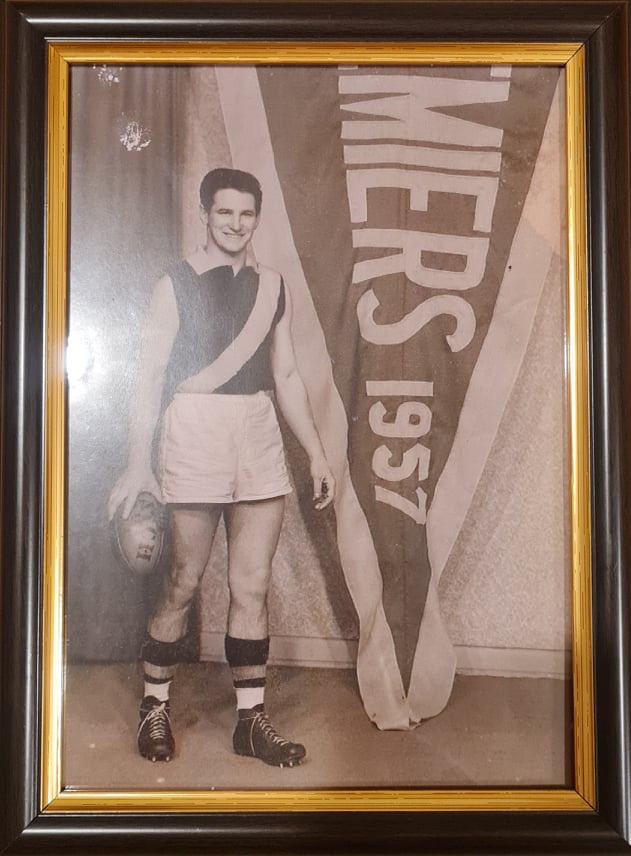
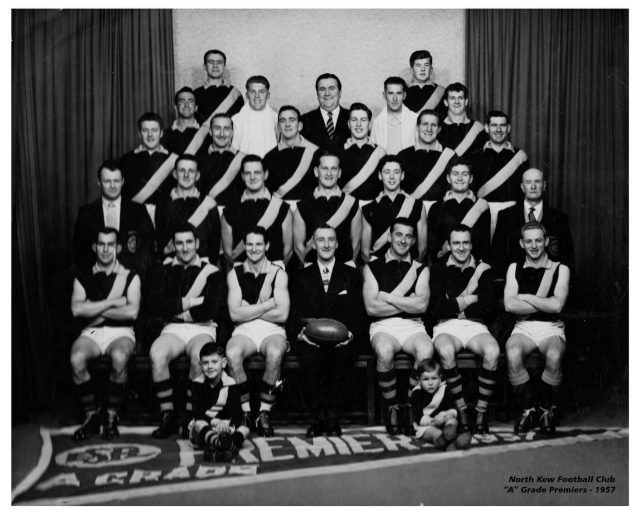
After a relegation to B Grade after the 1959 season, immediate success was achieved the following season when North Kew won the 1960 ESFL B Grade premiership in a nail-biting win over Balwyn, under the guidance of club great Tom Gascoyne. An outstanding leader of men, champion footballer and man, Gascoyne was more than simply a premiership coach. Across multiple coaching stints he developed countless young footballers, his influence extending beyond the senior side, coaching junior teams as well. Many of the senior playing group in the late 60s and 70s were coached by Tom at some stage in their junior years.
The early 1960s also marked a significant change in the competition landscape. In 1963, The ESFL would merge with the Caulfield-Oakleigh District FL to form the South-East Suburban Football League (SESFL), of which North Kew became a founding member. While premiership success proved elusive during much of the 1960s and early 1970s, the club remained highly competitive, reaching a preliminary final in 1962 before enduring the disappointment of a relegation in 1972.
Few clubs embodied the notion of a family club quite like North Kew. A quick look at the honour boards will tell you that the original families were still active in club affairs throughout the 1960’s and beyond. Generations of families, including the McGann’s (Terry, Tom, Arthur and Jim), Hillard’s (Norm, Ian and Barry), Allen’s (Bill, Peter, Mick and Steve), Searle’s (Alby, Allan and Graham), Cull’s (George, Rene, Greg and Jeff) and Jim & Garry Till, and the Jeffers’ shaped every aspect of club life, whether as players, committee members, coaches, volunteers or supporters. So, too, did the Dalton’s – Peter and Gary – whose mother washed countless jumpers over this time period, and the Magee’s – brothers Mick, Greg, Bernie, Kieran and Daniel all played and coached, while father Frank was an important administrator. In fact, all eight Magee children, including their daughters, played a role at club in some level over many years. Perhaps the most famous family name at North Kew, though, was the Charman’s. Reg, Peter, John and Jeff (aka ‘Joffa’) all served on the committee at different times, combined they played over 1000 games, and all four are life members of NKFC. Joffa’s remarkable tally of 348 senior games stood as a club record for many years, with only injuries curtailing what could have been a 400+ game career.
Club stalwart Alan Lowe became synonymous with North Kew through decades of committee service; however, he was most famous for running his legendary ‘Pleasant Sunday Mornings’. As hotels were closed on Sunday’s, punters came from far and wide, firstly at Victoria Park and then at Stradbroke Park, to have a drink and a bet hosted by Lowie. Although the legality of the operation may have been questionable, any concerns were eased by the fact that the local constabulary were frequent recipients of Lowie’s generous hospitality. Lowie was a driving force behind the strong rivalry with neighbouring Balwyn FC (now in the Eastern FNL)
Original North Kew Rover and Life Member Eric Benaim, whose son Terry ‘Bear’ Benaim is also an NKFC life member, became equally famous for running his weekly meat tray raffles at the Prospect Hill Hotel, which became such a local institution that hotel patrons would leave money behind the bar to ensure they never missed out on tickets.
On the field, North Kew continued to produce outstanding footballers despite often finishing in the middle reaches of the ladder. Bill Bennett won four consecutive Best and Fairest awards during the early 1970s while also claiming the South East Suburban Football League Best and Fairest and finishing runner-up twice. Earlier stars included D. Johns and Brendan Ryan, who each won consecutive club Best and Fairest awards, while Mick Allen, Dave Jeffers (three time best and fairest), prolific forward Wayne ‘Bing’ Crosby and ‘Joffa’ Charman became synonymous with North Kew.
Future VFL stars Robert DiPierdomenico, James Morrisy and Richard Walter all spent time at North Kew during their football journeys, but the greatest product of NKFC would undoubtedly be the aforementioned Roy Wright, winner of two Brownlow medals and a captain of Richmond. Ray McVilly and later Phil Maylin and Wally Lovett would join NKFC after careers at the highest level.
A new chapter began in 1976 when North Kew relocated from Victoria Park to Stradbroke Park.
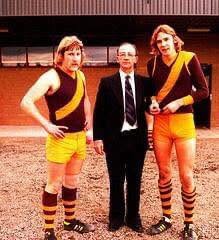
Around the same time, inspirational coach Gary Dyring arrived and provided a breath of fresh air with his fearless, uncompromising approach to football. While Senior premierships remained out of reach, North Kew enjoyed success in the Reserves and through its junior teams, with U15, U17 and U13 premierships arriving in 1977, 1979 and 1980 respectively. The Reserves delivered a memorable premiership in 1974 under coach Reg Charman. After a reality check versus Mount Waverley in the semi-final, a victory over Murrumbeena in the prelim would set up a rematch in the Grand Final. Reg was prepared this time, and despite Mount Waverley having stacked their reserves side for finals, North Kew produced a stellar performance to win its first open age flag in 14 years.
In to the 1980’s North Kew would continue to compete in SESFL Division 1 until a competition restructure in 1983 saw the introduction of a third division, following an influx of new clubs, and North Kew was placed in Division 2. North Kew would suffer a heartbreaking 4-point loss to South Melbourne Districts in the 1983 Division 2 Grand Final, and whilst another chance would arrive 3 years later in 1986, again North Kew would have to settle for runners-up, losing to Highett West in the Division 2 decider. The Reserves would win the 1985 premiership, however, with a famous 14-point win over Highett West.
Following the loss, senior coach Perry Isaac wasn’t reappointed, which saw the loss of a number of key players, including Runner-up league best and fairest Neville Roberts (after a 130-goal season!), Mal Niddrie and another group of players who returned to their previous club Upper Ferntree Gully. Legend Ray McVilly was invited back to the club as senior coach and, despite losing the loss of players, was able to get the team super fit and committed to the cause for the 1987 season. Having been taught hard lessons by the great John Kennedy Sr during his time at Hawthorn, McVilly’s tough love (including brutal trainings up and down the hills at Stradbroke Park, doing lap after lap carrying house bricks and pushing tractor tyres from one end of the ground to the other) galvanised the side, turning a would-be bottom 4 team into a runaway train in the second half of 1987. A loss to eventual premiers Ashburton in the final round, along with top-4 hopefuls Ashwood trouncing Carnegie, meant North Kew agonisingly dropped out of the top 4, despite having comfortably beaten all other contenders on the run home. Unfortunately, Ashburton were an example of the all-too-familiar case of cash ruining the fairness in local footy, as their team, stacked with ex-VFL and VFA stars were 20 goals better than the competition.
Ray would depart the club at the end of 1987, replaced by Ross Ferguson. The magic of 1987 wasn’t able to be replicated and despite a finals finish owing to an expanded top 6, it was a week 1 elimination at the hands of Murrumbeena. The highlight of the year would come against arch rivals Canterbury on their home deck, with Ross Ferguson giving the side an inspiring half-time pump up from an ambulance stretcher after a bad ankle injury. With even the ambo’s pumped and ready to join the fight, North Kew would come from behind to win a classic.
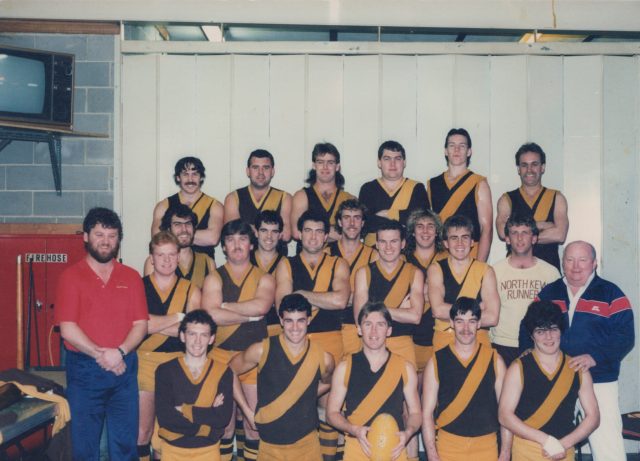
In 1989, Steve Sherry, ex Camberwell VFA reserves coach, would become North Kew coach as the club continued to compete in Division 2, before the return of Perry Isaac as coach in 1990. Isaac’s return bore immediate success and a finals appearance. Similar to 1987, North Kew stormed home smashing all comers on the way to finals, but unfortunately a determined and frisky St Kilda City would send the Bears out in the last 30 seconds of the final at Caulfield. 1991 was not as strong, as injuries and player movements costs the club in Perry Isaac’s last season. In 1992 SFL legend and ex Noble Park & Balwyn star Jimmy Hunt would have his first and only crack at coaching. Despite being a star player, injuries and a lack of depth saw the team finish near the bottom. Following the season, the SESFL, which had become the Southern FL, merged with the ESCFA, and North Kew was placed in Division 2. 1993 saw another new coach in Darren Hutchison join the club and, perhaps more importantly, Phil Maylin, a veteran of over 270 VFL and VFA games, including two premierships with Carlton, joined as an assistant. Finals would be achieved in 1994, with Maylin as coach, but it was again an early exit, this time at the hands of South Yarra. Gary Tyson took over as playing coach in 1995 and once again finals were made but with another early exit, however the seeds of something special were in place. Season 1996 wasn’t meant to be, with preseason injuries hurting the club’s chances of success, before a rebound in 1997 and 98, both ultimately without achieving meaningful success. The 1997 preliminary final was a tough pill to swallow, losing narrowly to eventual premiers Box Hill Pioneers on a wind-swept afternoon. And so it was, that we approached the end of the 20th century with North Kew having not tasted senior premiership success in nearly 40 years, and any open age success since 1985.
The Reserves had gotten close on two occasions. In 1990, led by Paul Blizzard, who would play 357 games for North Kew and become a life member, the Reserves team were ultimately knocked over at the final hurdle by a heavily stacked Tooronga-Malvern side, who also won the Senior flag that year. In 1995 North Kew were 25 points up in the fourth quarter before losing its two leading goal kickers – one to a serious injury and the other to a cowardly hit from an opponent – and were overrun by Heatherton to lose by 2 points. A devastating result.
Despite the solitary reserves flag, the 1980s and 90s had seen a number of champion players through the doors at Stradbroke Park. Mark Roberts was the star of the North Kew side during the time – five club best and fairest’s and two competition bests and fairest put him squarely amongst the greats of North Kew.
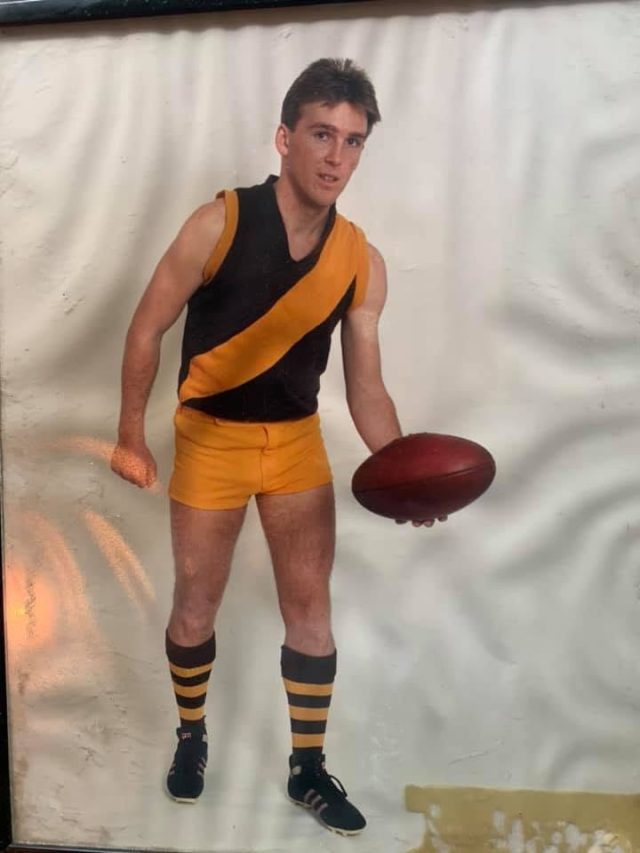
Perhaps only former VFL star Phil Maylin was a better player at North Kew in this era, as the tough on-baller was a class above the competition. David Meikle, nicknamed the ‘Big Fish’ due to his size and resemblance to Essendon’s Paul Salmon, also starred, rising to prominence in 1988 before being picked up by Springvale VFA in 1991. Jon ‘Zon’ Modica joined with Steve Sherry in 1989, and bamboozled opposition players week after week, while Craig Carpenter, former Box Hill VFA player, played some great footy after joining in 1993. Wally Lovett (the first ever indigenous player for Collingwood FC) joined the club in 1994, winning the Best and Fairest. Other great players included Anthony Roberts (Mark’s brother), John Charman, Mick Magee, Mark ‘Digger’ Harris, Tony Green, Tony King, Ian and Troy Ideema and the Bellisimo brothers. Ian Ideema kicked well over 100 goals in his two seasons, and Daniel Bellisimo was a great centreman. Craig Heard was another very good centreman who won the 1990 Best and Fairest.
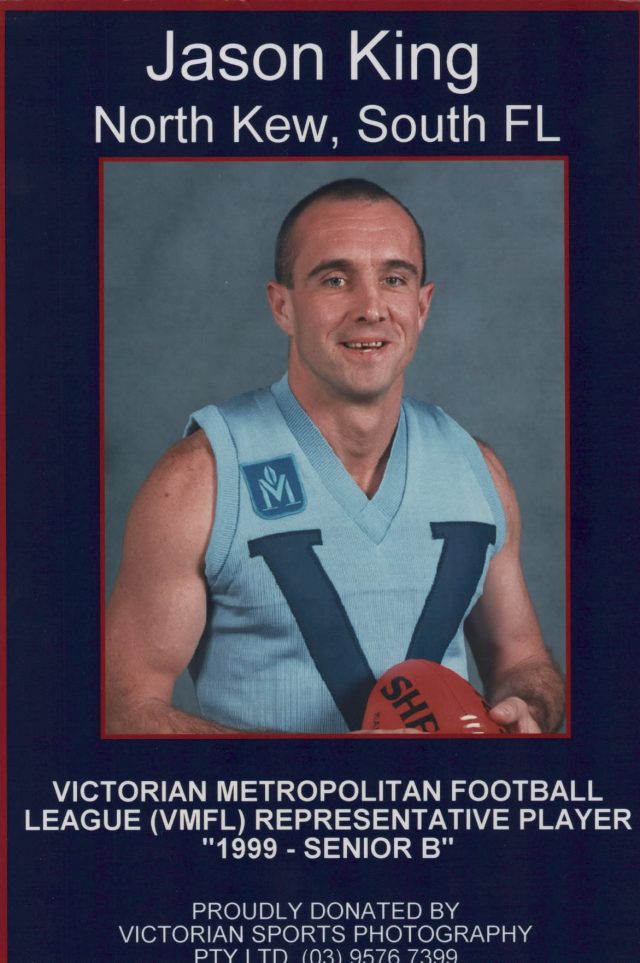
The club had been around the mark for most of the 1990’s, and whilst the genesis of a great side had been there, it all came together in 1999. Gary Tyson stepped down to move into a coaching role at the Western Bulldogs alongside Terry Wallce and his good mate Phil Maylin, and this paved the way for the return of former coach and legend Mick Allen as assistant to the newly appointed Jason King. King, an ex-Collingwood Districts and Seville premiership player, renowned for his toughness at full back, brought with him a motley crew of Collingwood and Seville players to complement the pieces that were already in place. The side had gun players on all lines – King at full back, Matthew O’Keefe in the middle and three huge ruckman – Jade Hill, vice-captain Stewart Cant and ex-Collingwood Under 19-star Ned Grubisic. Grubisic would be runner up in the Division 3 competition best and fairest that season, while Matt Harrison was the top goal kicker and best and fairest winner for North Kew. Harrison, was a Koori boy nicknamed ‘Smooth’ due to his cleanliness and class. Jason ‘Outer’ Inness was a tough defender; there was gun rover Dylan Flavel (ex-Western Bulldogs) along with long time loyal servant Damian Mills and the skilful Tim McMahon. McMahon was a super player and motivator who was runner-up best and fairest. Coach Jason King proved his quality, being named as a Victorian Representative in the 1999 ‘Senior B’ side.
The home and away season was dominant, just a solitary loss and a resulting top of the table finish, before eventually winning through to the 1999 Division 3 Grand Final against Highett. The Reserves also played in the Grand Final earlier in the day, but were pipped by a heavily stacked Carnegie team who would fold the next season. The disappointment of the early game was ameliorated, though, with what would happen next.
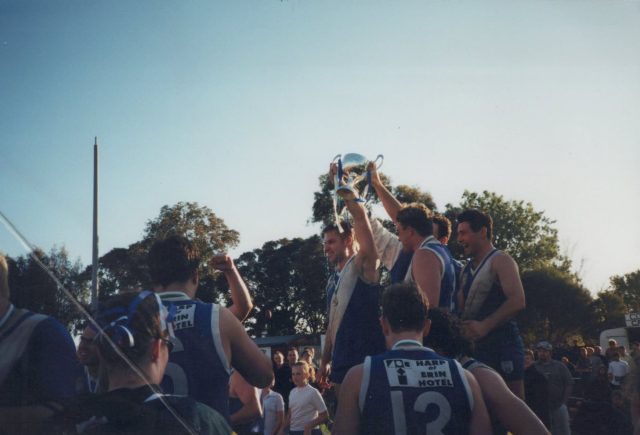
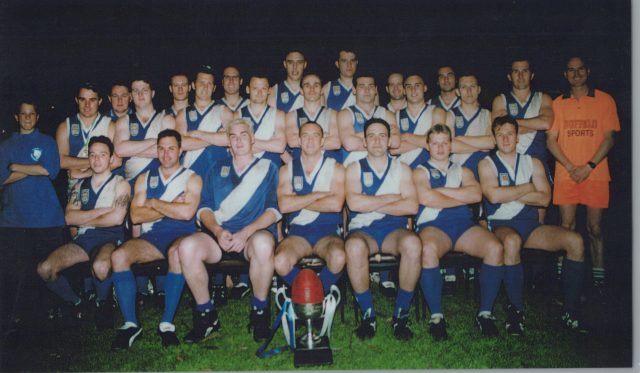
In the main event, trailing by 22 points late in the third quarter, a quick goal would see the final quarter margin reduced to 16 points. Scores remained unchanged for the first 7 minutes of fourth quarter, as the tension grew. Then, an 8-minute onslaught of four majors, first to Matty Harrison, then Bernard Brady, Grubisic and Harrison again, saw North Kew lead by 10 points. To its credit Highett fought back to get the lead below a kick. At the 23-minute mark a big pack mark and goal to Grubisic resulted in North Kew leading by 9 points, but the champagne corks had to be kept on as Highett hit back with an immediate answer; a behind and then a quick goal, cutting the lead back to 2 points. After just a few seconds of the resumption of play in the centre square, the siren would sound and jubilation ensued, as after 39 years and lots of hits and misses, the North Kew club had its first senior premiership! It’s safe to say that everyone celebrated hard. It was a memorable day in the history of North Kew, a third senior premiership added to the 1957 and 1960 triumphs, and the first in the Southern Football League. The club would be promoted to Division 2 for season 2000.
The 21st century would start with a strong season in Division 2, finishing fourth in the Seniors and third in the Reserves. Jason King would depart North Kew for Silvan, taking a number of senior players with him. Mick Allen would coach the side in 2000 and 2001 to strong results, but had to step down due to health issues. After the strong early returns in Division 2, North Kew would return to Division 3 for the 2005 and 2006 seasons. Back in Division 3, under the tutelage of a returning Mick Allen, the side was immediately competitive. Back-to-back grand finals were achieved, but unfortunately North Kew were on the receiving end of two defeats, and would have to settle for runners up. In both seasons, Moorabbin West and then Parkmore were significantly ‘cashed up’ teams filled with mercenary players – another indictment on the local footy landscape at the time.
The premiership glow of 1999 was not able to harnessed, as champion players, loyal committee members and volunteers moved on, and too much began to be left to too few.
In 2007, following 70 years of proud history, North Kew Football Club merged with Kew Amateurs to form the modern Kew Football Club. While the North Kew name passed into history, its legacy lives on through the generations of players, volunteers and families who built the club. The honour boards hang proudly in the Victoria Park clubrooms, and North Kew’s story remains an integral chapter in the history of the Kew Football Club.
This article was written with research and anecdotes provided by North Kew Life Members Terry ‘Bear’ Benaim, Paul Blizzard and Julian O’Reilly